
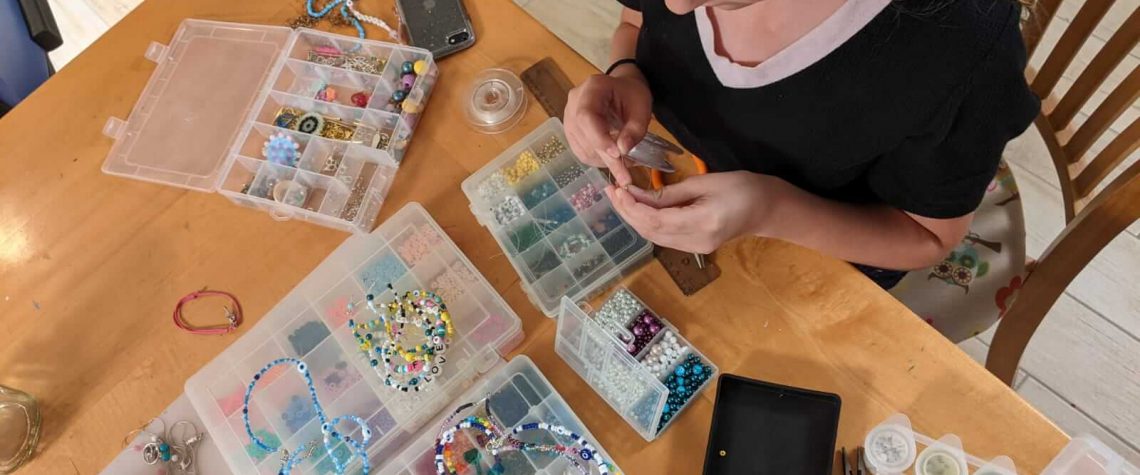
“Today we’ll make a necklace for my mother.”
Every mother has at least one piece of jewelry she will never part with— a piece strung by her child, in which all their pure, simple love is embodied; love untainted by conflict, frustration, or hardship. From the moment it rests in a box, a drawer, or a jewelry case—perhaps right where love letters are kept—it announces: “I have come home; I preserve the moment I was made; from now on I will always be dearer than anything that comes after me.”
When one turns to beads, love is already inside, even before we touch them—love for others or for ourselves. Beads make me think about their destination, and it’s hard to imagine myself beading while holding unpleasant thoughts, unlike when creating with other materials or expressing in poetry and words—there anger, pain, or sadness may appear. But not in beads strung on a thread.
I got married in the early 2000s—the golden age of beads. On every main street and in every mall, there was a bead shop; a common outing was a trip down to South Tel Aviv, the stronghold of beads, to buy them wholesale. Everyone was beading all the time.
During that period, I also worked in a bead shop, selling and teaching complex beading and weaving techniques in workshops. I remember how joyful it was to visit and linger in that bead shop.
In the center of the shop stood an old, heavy carpenter’s table, like a hearth; around it people gathered to play with all the possibilities, plan, match, and bead. I remember wondering what my role was in that situation: to support every idea in order to strengthen it? To just nod? To offer suggestions? To try to improve? To use the chance to sell as much as possible? Or to let the many, dazzling beads, arranged like a shimmering fan of color under diagonal mirrors, speak for themselves? It was clear to me that this was not an ordinary store where you buy and leave. Something completely different was happening there.
Many times I felt like a bartender or a hostess. There were regular visitors who used to spend long hours there every day. At first they came with a “reason”—they wanted to fix something, replace a piece they no longer liked with a new one, reinforce weak parts, get tighter closures for loose loops that tended to slip off at key occasions. Sometimes they brought an idea, a garment, a task.
Over time there was no longer any need to bring a concrete item for fixing or changing. One could come empty handed and let the beads speak in a space that gradually formed.
Beyond changing trends (which fortunately are lately showing signs of recovery—I’ve noticed people are again buying and beading beads, different beads but beads)—I tend to believe that that wave of beads faded precisely because of the social nature and the long stays in those bead shops. Despite the joy and deep significance of belonging to a creating group, economically it wasn’t sustainable…
When the shop emptied of visitors, I turned to beading myself, towards my impending wedding.
At first I beaded for myself: separate bracelets of small transparent beads. As a young woman in my early twenties, I felt I was investing in myself as if they were diamonds. I strung them on clear silicone thread, closed forcefully with pliers, and a simple silver crimp bead.
When I finished I wasn’t satisfied—I wanted more. I asked family members to describe the clothes they intended to wear at the wedding (who used to think of sending a picture then? And with a cellphone??). I made a necklace for each one, for some also matching bracelets. It amazes me now how fashion has changed, and how we used to wear matching jewelry sets—necklace and bracelet!
I beaded for all of them—my mother, my future mother in law, my sisters, and other female relatives, my own and my partner’s.
Beading calmed the unrest and natural anxiety that accompanied the wedding planning. I felt I was charging the necklaces and bracelets with bridal power, I was making talismans; there was special meaning in the Knowing that the jewelry I made would be worn on my wedding day. In hindsight, I think there was also an element of control—I thought it would feel nice to see around me things I myself had made on that day. I was afraid I wouldn’t feel that I was really there, that it would be mine, that I’d have a hand in it. Above all, I was very happy to gift the necklaces and to see the excitement they generated. In subsequent years I used to offer to my friends getting married that I would bead them a “bridal piece,” and I was glad to take any small part in making their charm, this time from another side.
Since then, to today I have a large box devoted entirely to beads. I might not touch them for years; at some periods I bead all the time, not only jewelry. They are very patient, they do not spoil; like those special pieces made in kindergarten for mother—they never go totally out of fashion, and their time will come again.
Sometimes I miss the act itself, so I find myself beading on an especially long thread, just for the sake of it. There were times when I turned those beads into tapestries, mobiles. “Mirtsedet” (Tapestry) is one of my favorite words in Hebrew. It holds all its magic and meaning in it.
There are materials I keep totally private from my clients and which will never reach the clinic. There can be “those kinds” but not those exact ones (for example, I might buy one identical set of a certain kind of bead for my own use and another set intended for the studio). With beads I do not separate; I enjoy the private knowledge between me and myself of their value and of the many years of experience of my beads, and I very much enjoy seeing them beaded and embedded in my clients’ works. I see them leave me and know that their place is there, that their destiny is to be outside the multi compartment tray and to serve others.
There is something encouraging about accompanying a client who works freely and without inhibitions, creating intuitively, with no worry or fear about the quality of what comes out. A client who creates for themselves and as part of a process of release and of coming to themselves, who uses materials as tools helping to get closer to who they are.
I remember how in the past I used to shrink in my chair if a client came and proclaimed something like “Today I’ll make a necklace for my mother!” or “My friend has a birthday so I want us to make the greeting here” (not only little children, by the way). At that time, I tended to think perhaps nothing very significant was happening, that for them the meeting between us was merely practical and nothing more. Gradually I learned how complex every patient’s heart’s desire is and I stopped being startled or thinking the wish to create for others is lesser.
Today I find myself offering beads to patients who are greatly pre occupied with the condition of those around them. I no longer try to banish the seemingly practical desire to make gifts for others; on the contrary, I invite it to stay, and I offer that we hold, together, patient and therapist, that desire. I remember again that personal place of mine, which gave me strength and relieved anxiety by giving to significant others.
Maybe that’s where the magic of beads lies—they are not expressive in the sensual tactile sense. They are hard, inflexible, unaffected by the touch of the hands; they do not change shape. And yet they are very communicative materials, can be given to others or received from them when they are charged with meaning, even when they are beaded by us for ourselves. They convey a lot while being worn; they allow strength and comfort.
I would love to hear about your beads—do you also still have a bead collection, and what is its place in your life—today, in the past, perhaps are there certain beads with a special, exceptional value?
