For 16 years, we raised a difficult and complex dog, and I thought that’s just how dogs are—everyone has quirks and complexities, like adopting an orphan from a war-torn region. It always required a lot of effort, attention, and training, constant learning, and every time we thought we understood—things changed and we had to learn again.
Two and a half years ago, when Bijou finished his time here, after a very hard period of being fully dependent, I admit I felt some relief, not only sorrow. Relief because I felt some tension lift, that I was free, that I no longer had to find very specific arrangements with supervision at home whenever we went out for more than a few hours (he never liked traveling, other dogs, strangers, or changes in general). So yes, I loved him very much but I also felt relieved.
For a while.
Very shortly after, much sooner than I expected, a great emptiness and distress crept into the house without animals. Everyone here stopped mourning and wanted us to bring a new dog, but I couldn’t and sabotaged it again and again. Then came the pandemic and it was somewhat forgotten (we were even glad to avoid walking a dog during the frightening first phase of the lockdown. Later, we regretted having no reason to leave the house…). Between the first and second lockdown, we moved to a rural, open area; the fields and orchards around the house reminded us that it was a great environment for a dog, and how unfortunate it was that Bijou didn’t get to spend his life in the countryside.
But I still didn’t want one. Not at all. I was beginning to come to terms with the idea that I had passed that stage, like accepting that I would no longer have babies, and that was perfectly fine—good, even, and I faced the rising sun and the future with various denials and veils over a simple, raw desire that there would be a dog here, that I would manage to overcome the fear and uncertainty of what would happen if I dared open my heart again to a new creature, trusting it and us that it would be okay.
Last Hanukkah, I started sneaking glances at shelter websites at night. Just to peek, to see what’s new and how it works now. It’s been almost 20 years since we were last in this situation. How do you even choose? How do you know what you want and what will work? How do you know you’re a good match? How do you make sure it won’t be so hard again? Now the kids are involved too. The oldest is pretty indifferent to all this, as long as it’s not a cat (she’s very allergic). The middle one won’t stop talking about a Siberian Husky—that’s his dream. But Omer really isn’t into it, and honestly, neither am I—it always seemed strange to have a sled dog in the Israeli heat. The youngest wants Bijou number two—like Shuki the fox dog—but every time she sees a picture of him, she cries immediately, so maybe something completely different would be better?
Before her birthday, we decided to launch a secret mission: early Saturday morning, we went to the SOS adoption center in Herzliya, the place where it all began. On the way, we rehearsed and aligned our strategy—we’d take a small, simple dog, no complicated past, quiet and not barky, no visible injuries, not a puppy and not too old, one the kids could easily take for a walk by themselves. This time we’d be focused—we already had experience.
It turns out we weren’t the only ones early— the center was already quite full. Again, the scenes I’d avoided for years, and I knew why. Despite the great love shown by volunteers all around, and the fact that dogs aren’t kept in cages but only in loving foster homes (I salute anyone who does this!), the experience still feels like arriving at an orphanage. It’s so sad to me, my mind stops functioning and I kind of enter another zone in my brain and heart, trying to focus and screen out all the happenings around me, to listen only to a voice that speaks directly to me and says, “I’m here, I’m yours.”
Again, just like almost twenty years ago, it happened pretty much immediately.
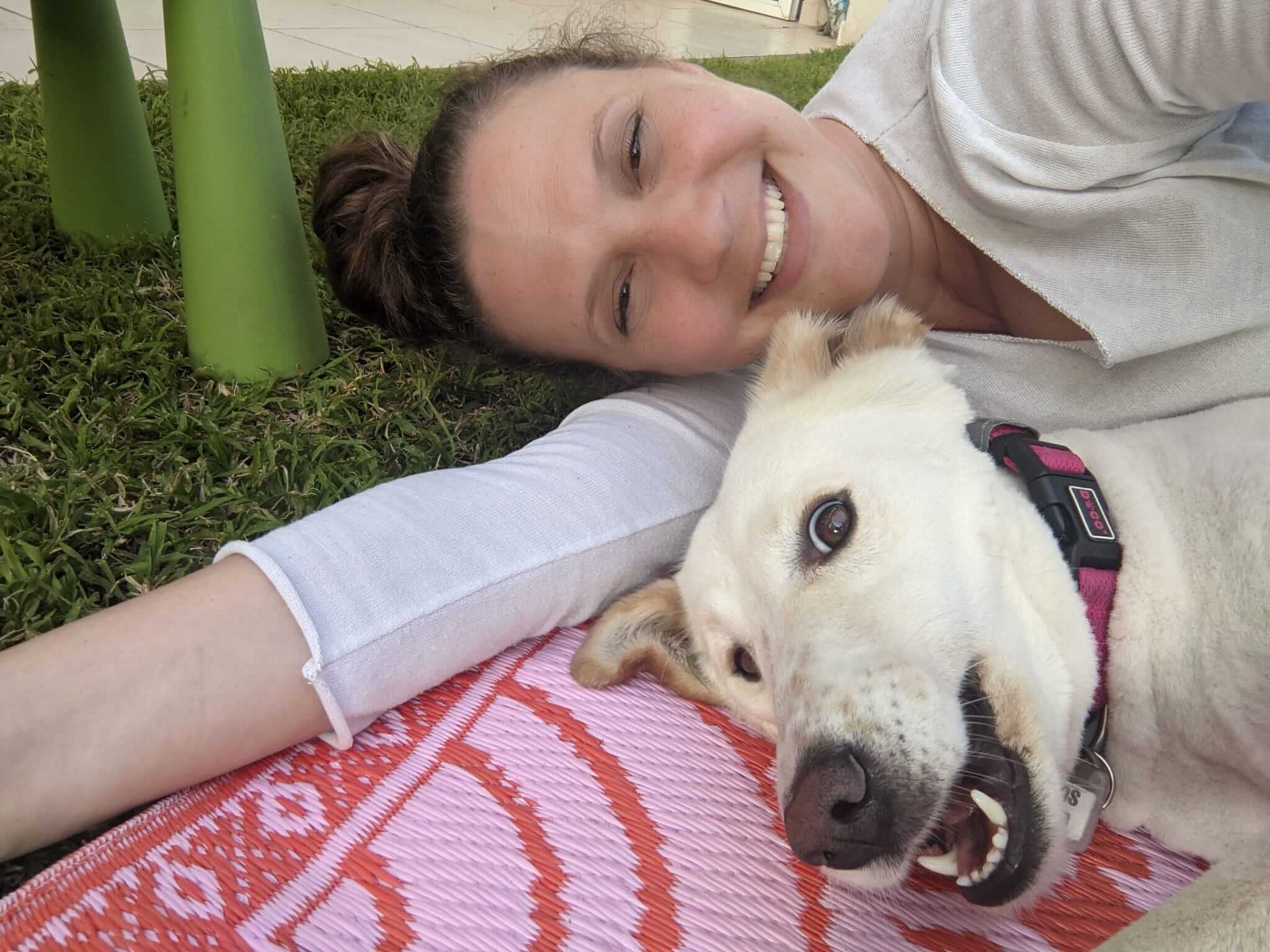
A very large, round, white dog, in pain, with a swollen leg for an unknown reason and a very shaved belly. She was crying bitterly, like a woman crying after something terrible happened to her. I approached her and immediately another dog jumped on me—similar but thin and hyperactive—licking my entire face, performing tricks and stunts meant to make me fall in love instantly. The crying dog recoiled immediately and curled up in her place, and I followed her. She was ripe, crying, sad, drooping face, tail between her legs. She rested her head on me and howled, really speaking. It wasn’t hard to understand she was at rock bottom in her life.
From the volunteers we learned very little about her—only that she was found wandering in the Bedouin area with several puppies. Those that survived, of course, were adopted easily, and she was neutered quickly under quarantine in Be’er Sheva before arriving here. When they described these few facts, I hardly heard them, as well as the fact that the swelling on her leg was unexplained and her general condition was uncertain. At that point, she was already ours, and I knew all that rehearsing on the way was in vain—she was our dog, even though she was exactly the opposite of what we planned.
For the first two months, she cried nonstop. She was still very swollen from giving birth and in pain from the neutering; we gave her painkillers that helped a little. When she needed to pee, she would stand in front of a stone wall outside and rest her head against it, as if creating some kind of counterpressure that probably eased her pain. It took her a few weeks to understand the concept of walks on a leash. It was very embarrassing for her to relieve herself with someone standing by. Why do we have to come everywhere with her? A real mystery. Nevertheless, she never showed aggression at any point and behaved very gently, like walking on tiptoes. That’s why on her first day here at home—we called her Easy.
Months passed before she barked for the first time. She doesn’t dare go up to the living floor and stays very close to her bed in the living room. Once she got on the couch, and after we told her “No,” she just stopped trying. At night, she would chew the edge of the curtain and carpet in her mouth and calm down until she fell asleep. I sewed the small holes she made and embroidered flowers and patterns over them, ignoring the small damage, knowing it was temporary—and indeed it was.
It took time, and maybe things will still change and improve, but today, nine months since she’s been with us, she’s in a completely different place. She learned to play ball in a kind of clumsy puppy way. She gets along amazingly with everyone—people, kids, animals—not just dogs. She truly loves all living creatures, can happily play with cats, and is delighted when on an evening walk she encounters a hedgehog in the field, or even an insect or lizard, giving them a gentle, licking kiss.
She welcomes everyone who comes home warmly and gently. I’m sure she knows how to distinguish between “regular” guests and those coming to the clinic; she’s especially gentle with patients and allows a different kind of interaction. Some start every session with a very long hug with her, sometimes sitting next to her on the floor. It’s hard to leave her, and we almost all regret that our time is limited and we can’t sit with her like this all day every day.
She reminds me of a cow, making me believe that this is what it feels like to raise a calf, a cute little farm animal (I always wanted to raise a cow or a sheep). She loves touch so much that just approaching her makes her roll onto her back, offering her front legs, asking us to play “bicycle” or at least massage them a bit. She also loves to nap spooning, and she’s just the right size to be my little spoon. She rests her head on my arm and I pray she’ll fall asleep on the carpet before my arm starts to tingle.
She also barks sometimes, usually from joy, and sometimes she even talks—really talks—like Martha, the yellow dog from the show who swallowed a letter soup. She makes those talking sounds when she needs something and it’s very easy to understand what she’s saying.
I think she’s still very sad and in pain inside. She has a special place in the garden, under a big fragrant forest bush, where she digs a little every day—a place of her own to rest and cool off. When she’s there, I think she feels more herself, returning to the familiar, to the desert soil. Sometimes I want to enter that cool crater with her to better understand what it’s like to be her, maybe to help her feel less alone, to convince her that the puppies that survived the transition are in very good homes, that it all worked out in the end, and she has nothing to worry about. And that I’m sorry for all the hardships she’s been through so far—the physical pain, parting from her puppies, and all the other stops along the way—and I hope our home is a fitting compensation for all that. I sit and think about all this sequence of events and cry. It almost enrages me, all the sadness and sorrow this love in the shape of a dog, weighing 30 kilos, brings with it. Why must it always come together? Why can’t it be simpler? How did it happen again, despite many efforts, that we didn’t simply bring an animal into our lives like people do, which we intended as well? Instead, I now have here a real baby, a dog with a human-dog face—gentle, looking into my heart and mine into hers, a giant mirror, a disco ball of emotions. Can I shape less sorrow and keep only the joy and peace she brings? I hope so, but I’m really not sure that’s what will happen.
Recently, I’ve started playing with the idea of bringing Easy a friend of her own. She loves animals so much; since I can’t bring a cat home because of allergies, maybe a small dog or dogs that could enjoy her protection, her big heart, her gentleness and playful puppy nature. Maybe that way she’ll be less sad and lonely, less bored, maybe it will improve everything. Or maybe it’s endless, and even then I’ll feel it’s not enough, maybe then I’ll have two sad ones here. No no no, that would definitely be too much.