I really wanted this to be a short story with a simple, happy ending. I promised myself that when it finally came, I would write it all down, from the beginning to that ending I had been waiting for, the straightforward, uncomplicated ending I had imagined for the story of the hostages. I thought it would be a very short story, about a hostage-taking incident that would be resolved within a few days.
The day all the living hostages returned was a gut-wrenching day, an intense and extreme version of the entire emotional spectrum. At the end of it, I decided to sit down and write the story from the beginning. But I couldn’t. Every time, I would choke up and get tangled in the details. I kept writing notes to myself in all my lists that I had to finish, that the longer I waited, the harder it would be to remember the small, important details. I hoped that, contrary to all expectations, more hostages would return alive and we would be pleasantly surprised. I kept imagining Shiri, Ariel, and Kfir Bibas returning safe and sound, last but not least. I imagined Shiri telling Ilana Dayan how they had been kept safe. The truth, of course, was light-years away from that.
This is a long story, and it took me a long time to write it. That is unfortunate in many ways, but I still hope there are a few rays of light in it. For us, it was (and still is) enormous.
The story of the Yellow Bracelet Project
?How it all began
October 2023 was a month of paralysis and shock, of helplessness, and of very difficult days at Hillel Yaffe Medical Center, where I was working at the time. (It feels as though that was a lifetime ago.) Despite the hospital’s distance from the Gaza border communities, wounded and injured people were brought there. I mostly remember how stunned I was to learn what counted as a “mild” injury in an event like this, including amputations and, of course, psychological trauma. Those mornings were deeply unsettling for everyone. Against the backdrop of everything happening outside, trying to maintain some kind of routine in the mental health department was a real challenge for all of us.
The drive home along the coastal highway meant half an hour of transition from all of that to the shock of the children waiting at home. These were the weeks when the scale of the disaster was becoming clear. Schools and other educational settings were closed, everyone was scrambling to find a wooden beam for the safe-room doorframe and get the door fixed, stockpiling food and preparing for the end of the world. All the parents were frantic with worry, nobody was sleeping, and the accumulated exhaustion was taking its toll.
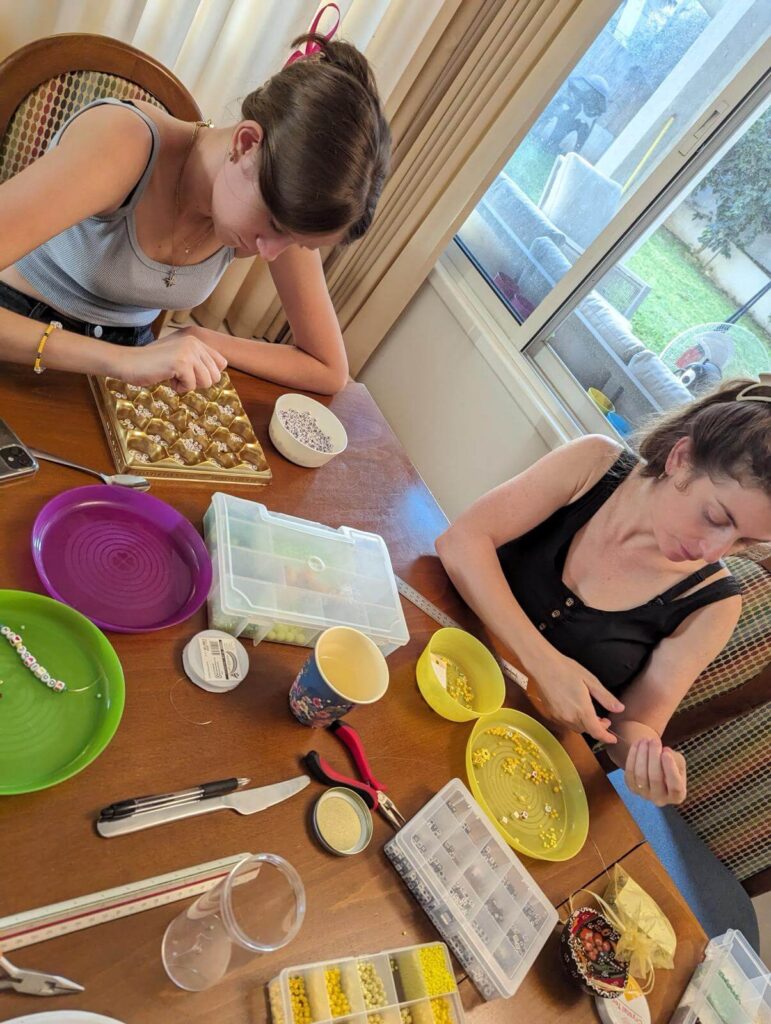
My younger children were less exposed to the unfolding events. We didn’t watch the news around them and tried to shield them from the horrors. Naama, our eldest, had celebrated her fifteenth birthday just four days before the world changed forever. Her response to the events she encountered in those first days was entirely different, despite our efforts to help her process them in a way that would make things easier. I’m not sure there was anything we could have done to make it easier, or any way to arrange reality for a girl just starting high school without shaking the foundations of life in Israel as we had known it until that day. I was looking for a practical way to create positive anchors in our new routine. Since art and working with materials are my primary language, I looked for a simple, accessible way to use them. Almost immediately, I decided to turn to beads and make them available to all the children in our home.
To me, beads are a very simple, meditative material. There is something about the repetition of the action, its simplicity, and the fact that within a short time you have something tangible that you can carry with you afterward, almost like a talisman, or an object imbued with meaning and power. I wrote about this a few years ago, and since then those words have taken on a new meaning. I invite you, too, to read by clicking on this line.
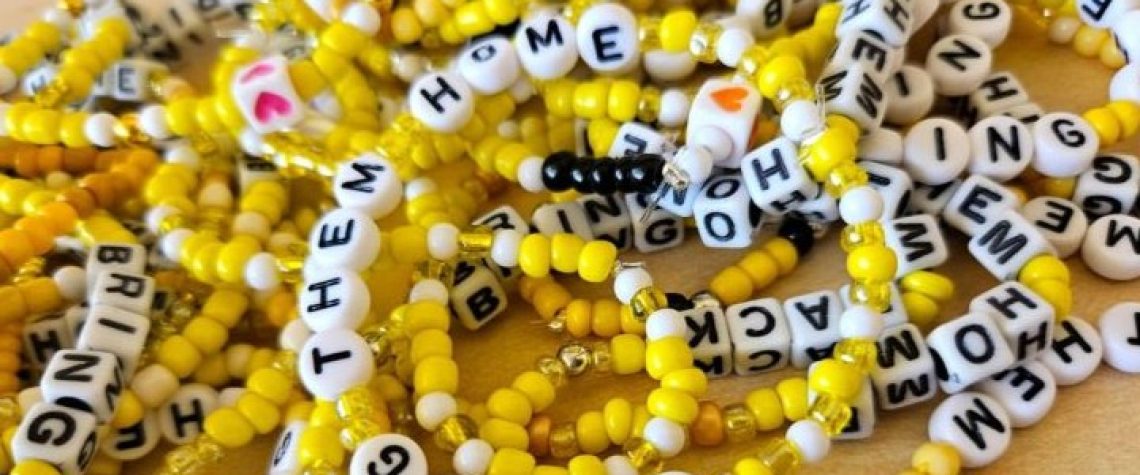
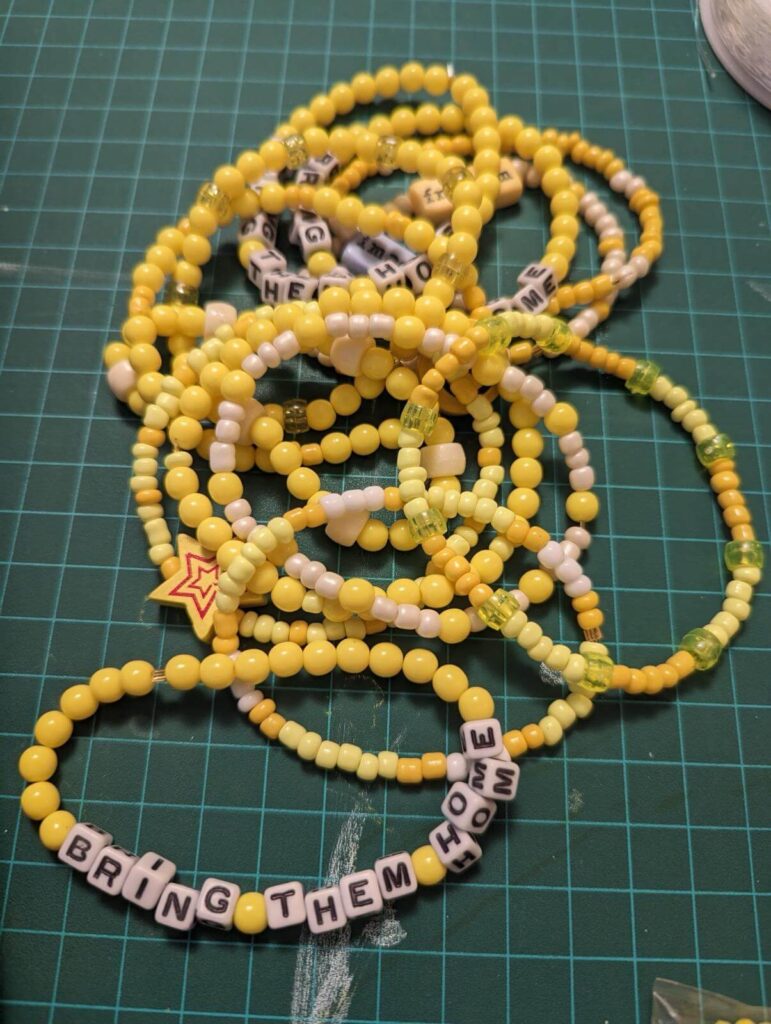
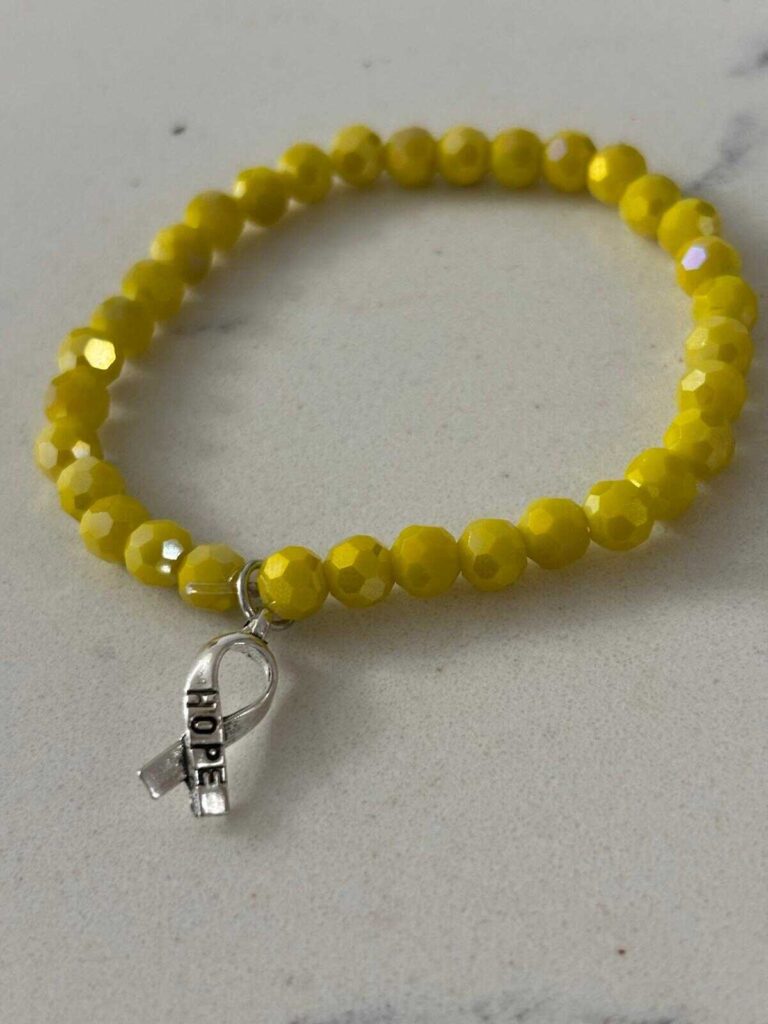
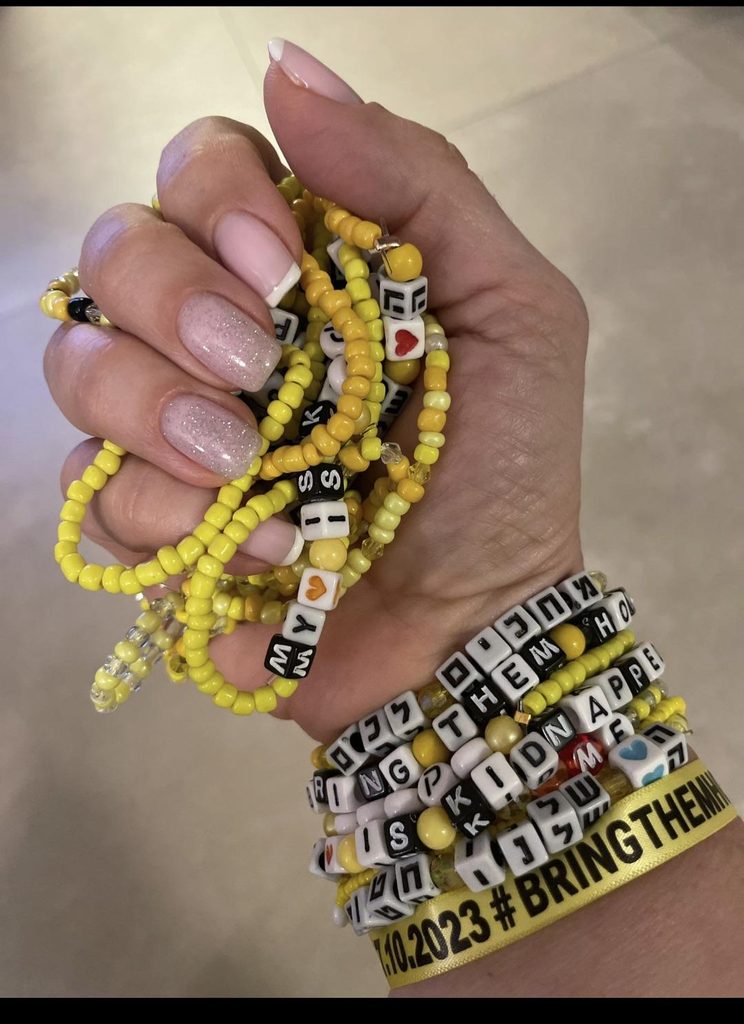
On October 8, the Hostages and Missing Families Forum was established. Within just a few days, it had developed a distinctive visual language that caught my attention: red and black clothing and signs bearing photographs of the hostages; the direct, simple slogan, understood everywhere, “Bring Them Home”; and the color yellow, which for many years has universally symbolized the return of soldiers and prisoners of war. The last two elements resonated with me, and almost casually, I suggested to Naama that we make yellow bracelets with those words, using the beads we had at home.
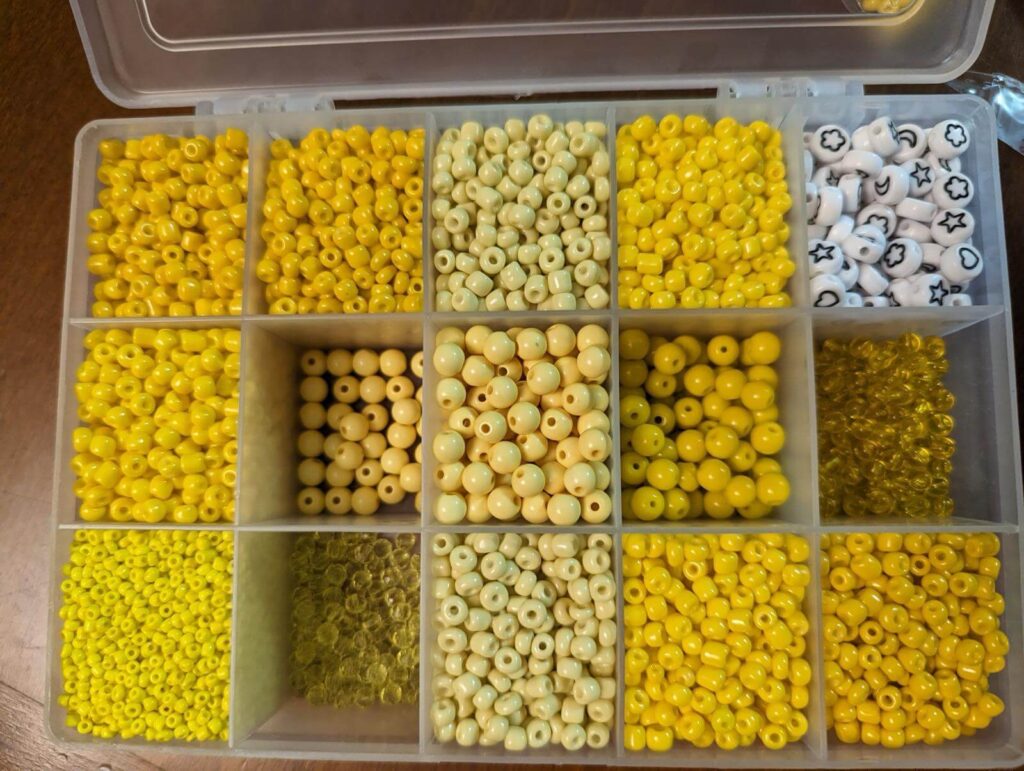
At first, we made the bracelets just for ourselves. When we saw how much interest they attracted, we decided to make them part of our evening routine and sell them to people in our immediate community, with the proceeds going to support the Hostages and Missing Families Forum, which had begun fundraising for its campaign. At the end of October, we posted photographs online for the first time, and suddenly we started receiving requests from all over the country.
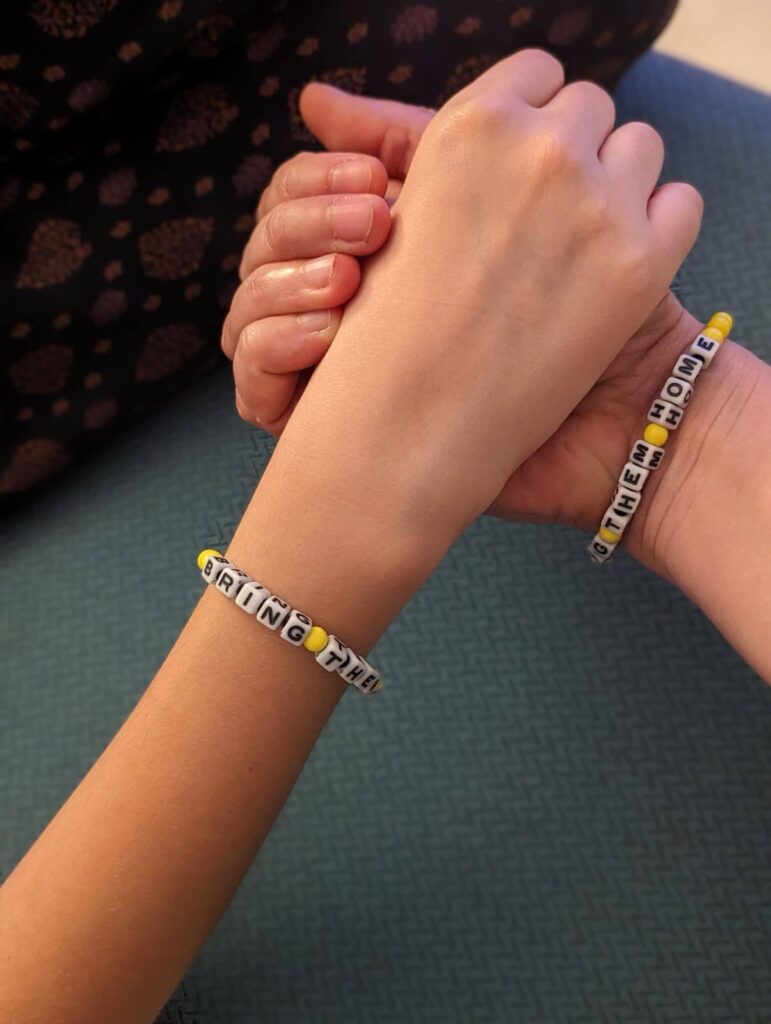
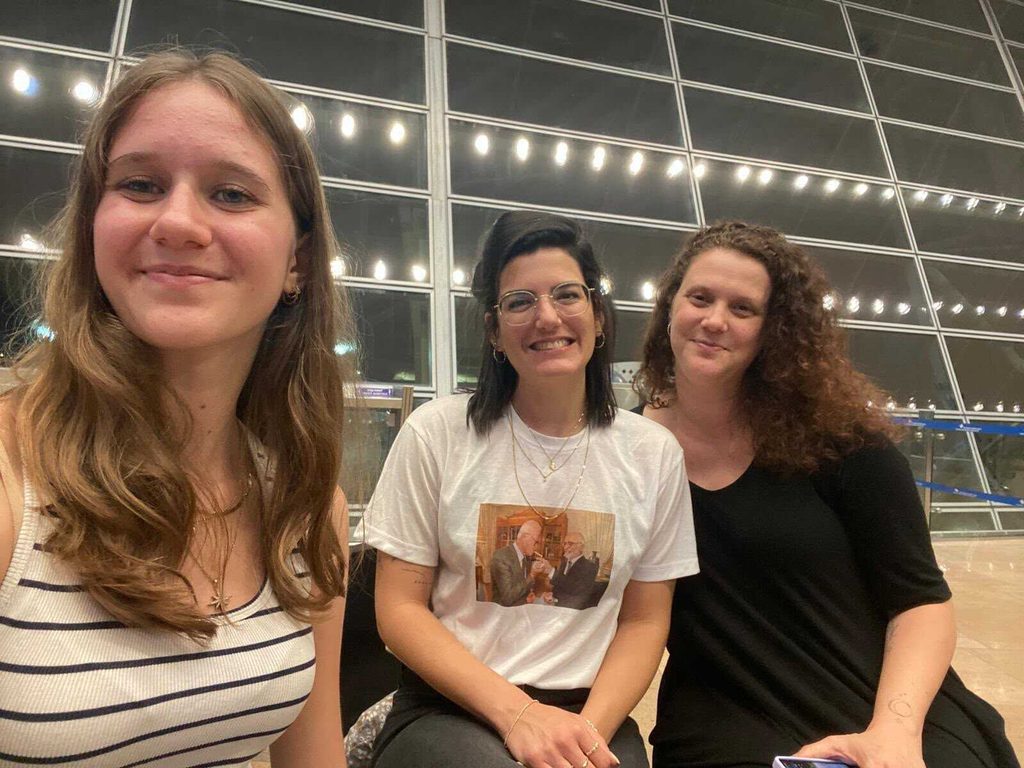
At this very early stage, between funerals and in the midst of such terrible days, a friend of mine who is like a sister, Naama Rivlin Angert, joined us. We felt that expanding our small circle from two to three changed our beading routine. The end-of-day ritual became more meaningful and far-reaching. In a very short time, Naama became an absolutely central figure in the project as it took shape. I cannot imagine it without her. The fact that she joined us so early and played such a significant role in shaping our path throughout the process was one of the main reasons we were able to persevere and keep expanding the project. We supported one another, each in our own way, and each of us had her own voice and a place of her own. Whenever one of us grew tired and discouraged, the other two kept moving forward. There was room for all of us to get tired sometimes, gather our strength, and return.
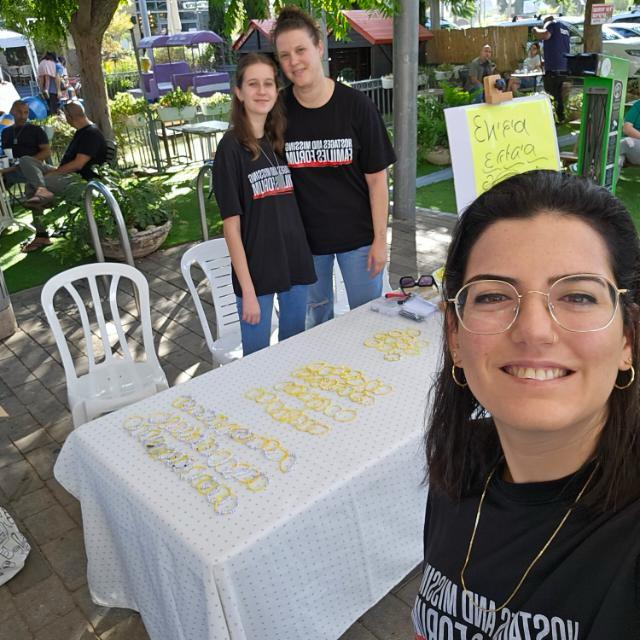
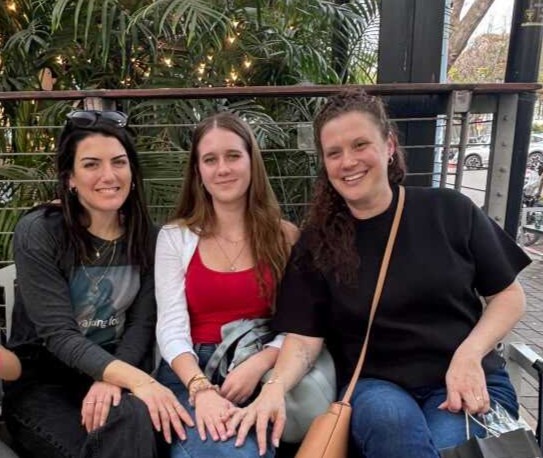
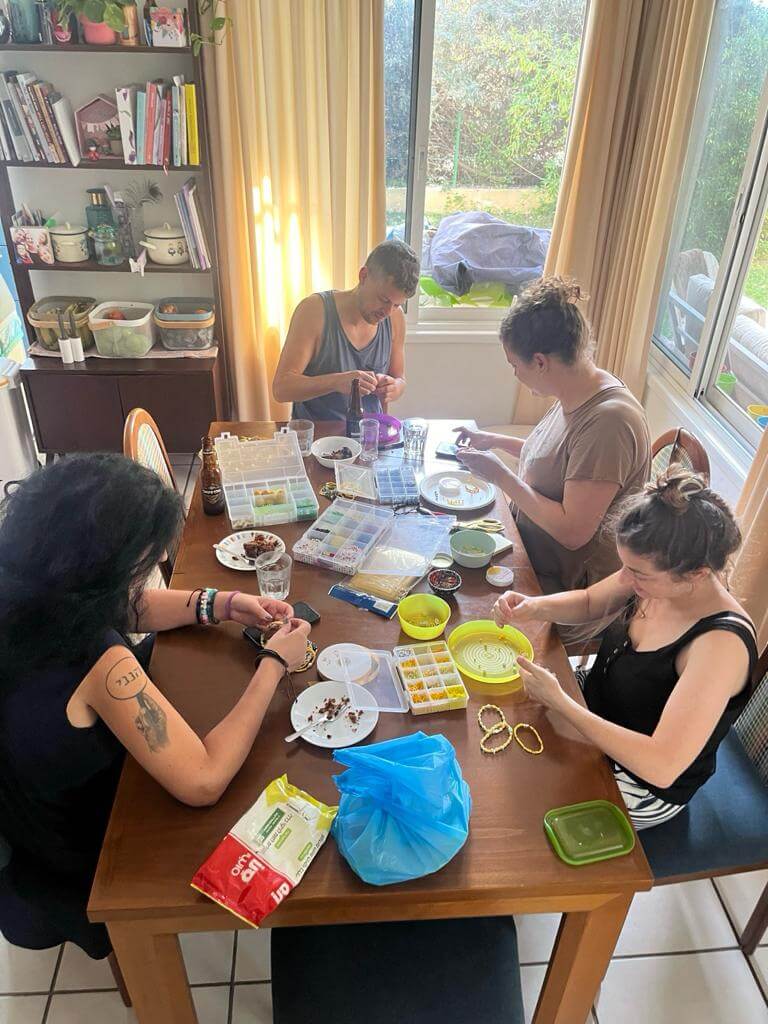
The beading station became a permanent fixture at the center of our home, and everyone who walked through the door joined in. Gradually, people began coming specifically to lend a hand and help us keep up with demand, while also finding a way to feel useful. The “end-of-day rituals” became “all-day rituals.” More and more women joined us regularly, working both at our home and in their own homes: friends, family members, and women who had come across the project online and wanted to take part. This made distribution and logistics much easier. Gradually, every region of Israel had a hub where bracelets were made and distributed, with the proceeds going to the Hostages and Missing Families Forum.
Other partners helped with distribution and sales, including fashion stores such as ATA and Shderat HaMeyatzgim / Tula in the Hefer Valley, followed by so many other businesses that there are too many to name. Thank you again to all of them! It was a beautiful and extraordinarily generous partnership that began in the very first days of the war. I was deeply impressed by the willingness of businesses to contribute their time, energy, and money to this cause at a time when it was so difficult for everyone to function. Perhaps after so much time this now seems obvious to us, but it wasn’t obvious then. We were all learning as we went along. The willingness to take part and respond to something circulating online simply because it mattered and could help is something I carry in my heart.
Taking it outside
For many long months, people all over Israel volunteered everywhere they were needed: helping residents of the Gaza border communities who were staying in hotels and elsewhere, supplying equipment and meeting the needs of soldiers, working in agriculture, and much more. In December 2023, Ayala, a teacher at the Democratic School in Modi’in, contacted me after purchasing a yellow bracelet through the website of a fashion store. She didn’t even know I lived in Modi’in or that my children had once attended that school. She suggested that the high school students get involved in making the bracelets, which would help us meet the enormous demand much more easily. “Our contribution will be our hands,” she said, “and anyone who wants to will also be able to purchase the bracelets made during the gathering.” This was the first time we had presented the project to such a large group of people. It was only a few days after the first hostage-release deal, which had not unfolded as we had hoped. (I remember a point when we even thought the gathering and the additional bracelets might no longer be necessary. I wish that had been true.) It was also the first time hundreds of bracelets were made at once and dozens were purchased at a single event.
We left that gathering understanding immediately how much power there was in doing something together, and how important the act itself was, not just the donation or wearing the bracelet.
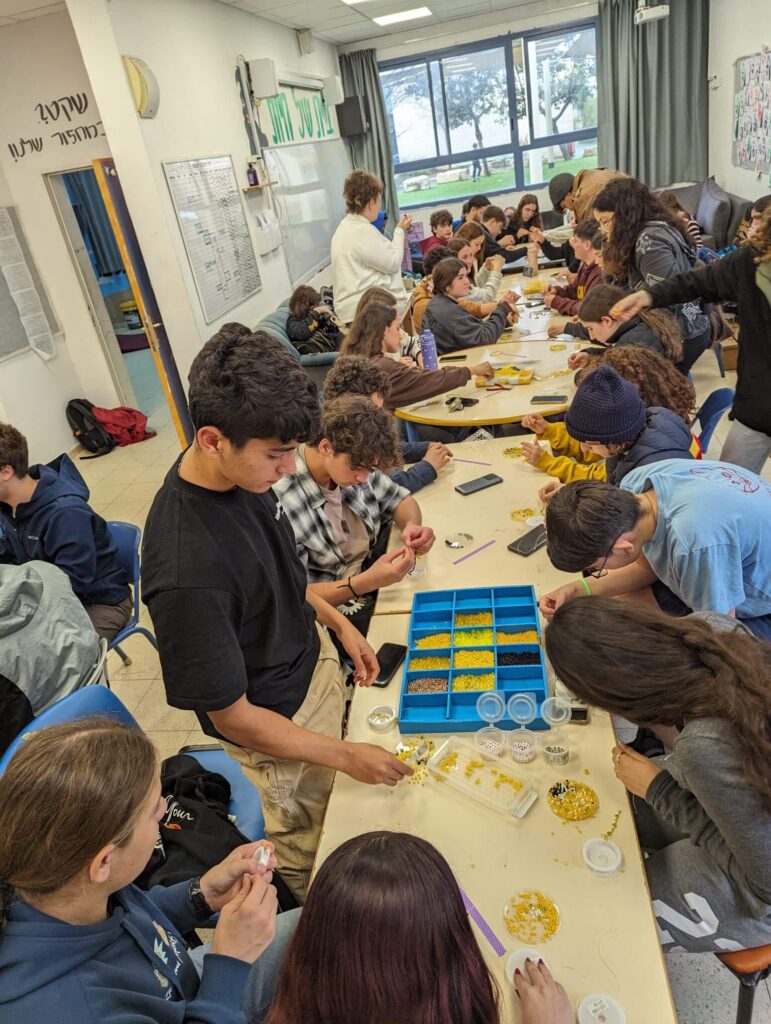
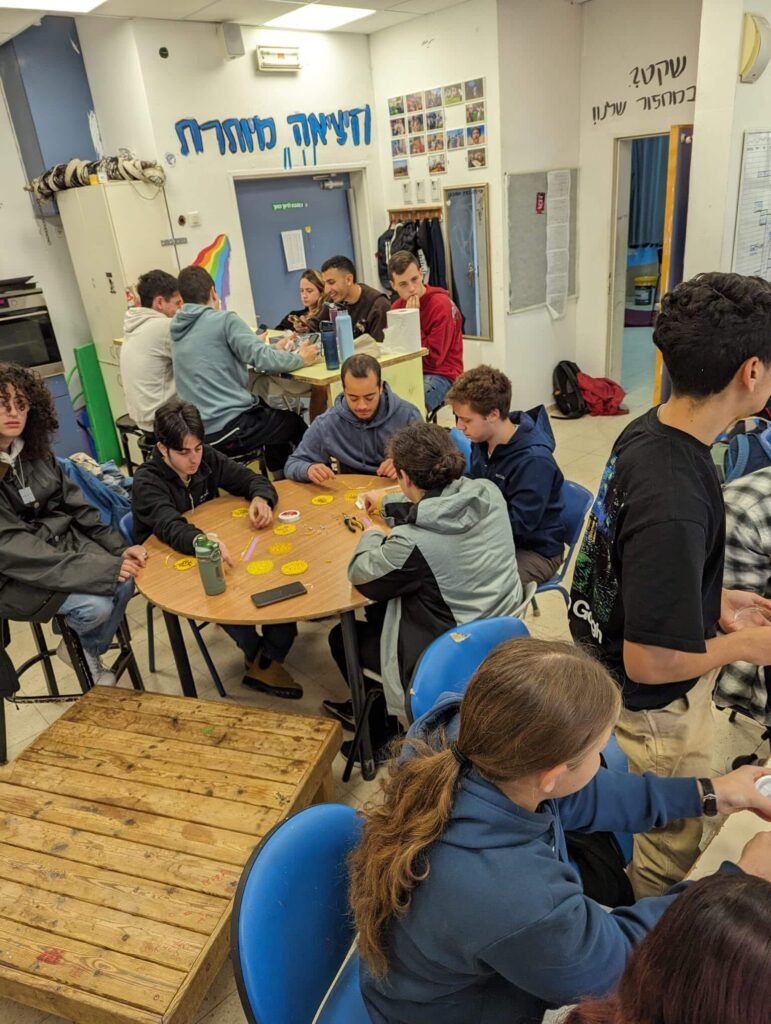
Within a short time, we began crisscrossing the country, holding more and more workshops. By then, we were a large and growing team, able to reach almost anywhere in Israel. Dozens of coordinators and local leaders were responsible for making bracelets, running workshops, and keeping the hostages present in public spaces and public discourse. We called our WhatsApp group “The Yellow Bracelet Unit,” and it truly was a unit. Its members included family members, old friends, and women we met through the project who will always have a place in my heart. It was an organized, collective effort, overwhelmingly led by women, centered on circles of women beading together. Those circles offered much more than bracelets. They created space for healing, resourcefulness, action, and the restoration of a sense of meaning and agency during days that were devastating, despairing, frightening, and filled with a very real and justified existential terror.
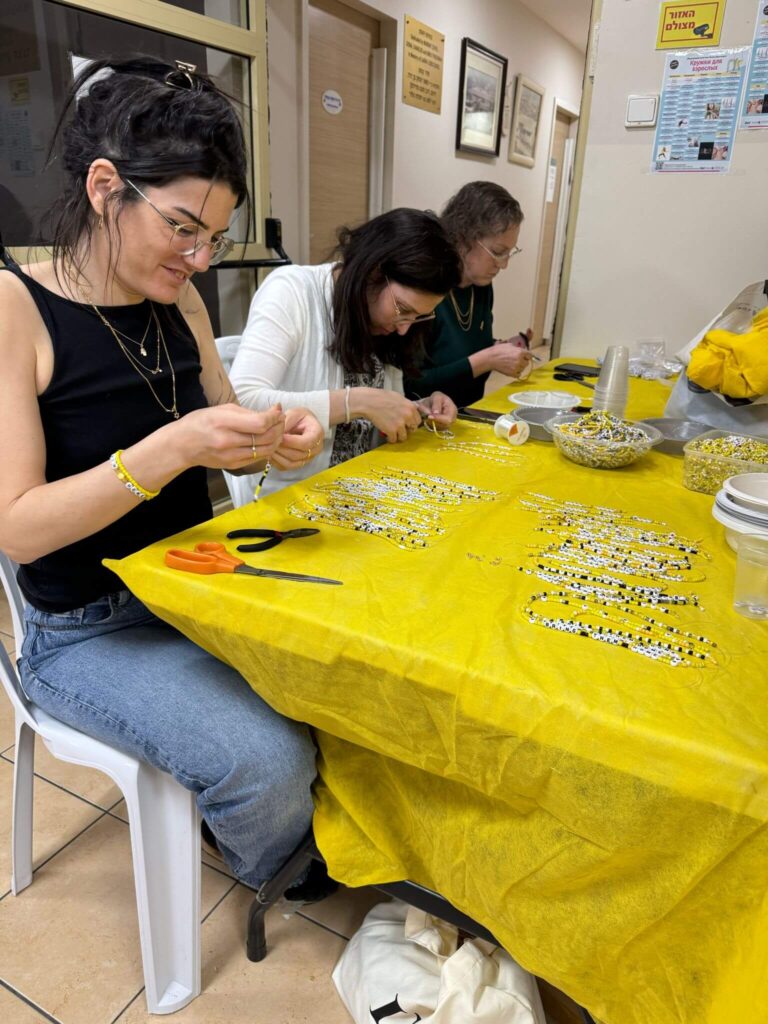
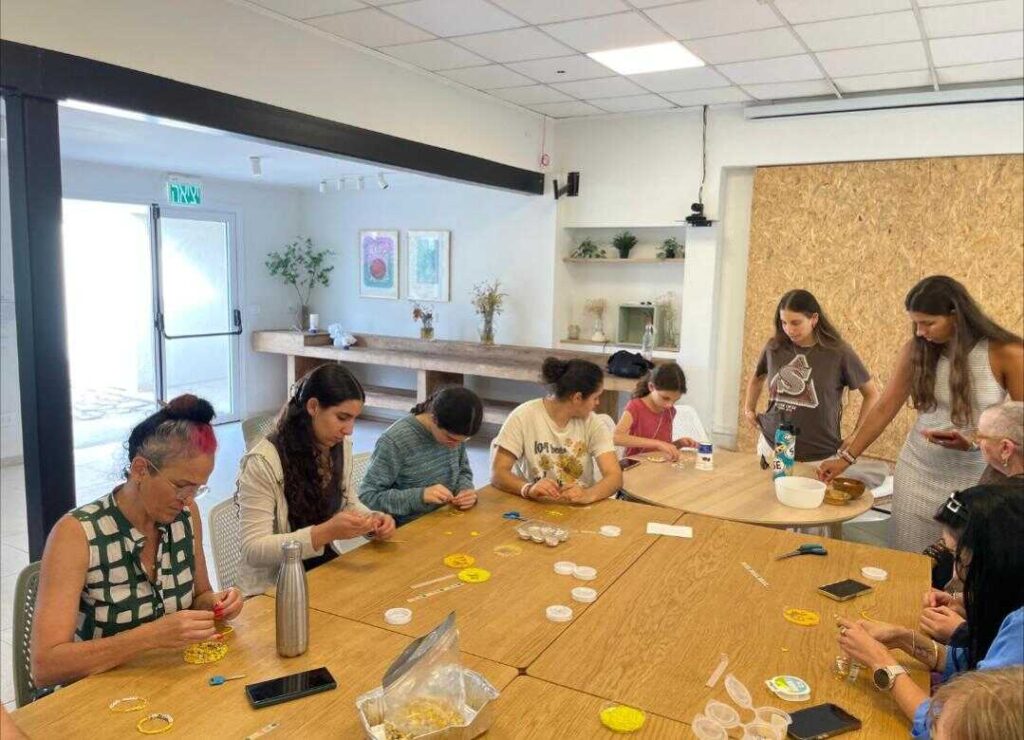
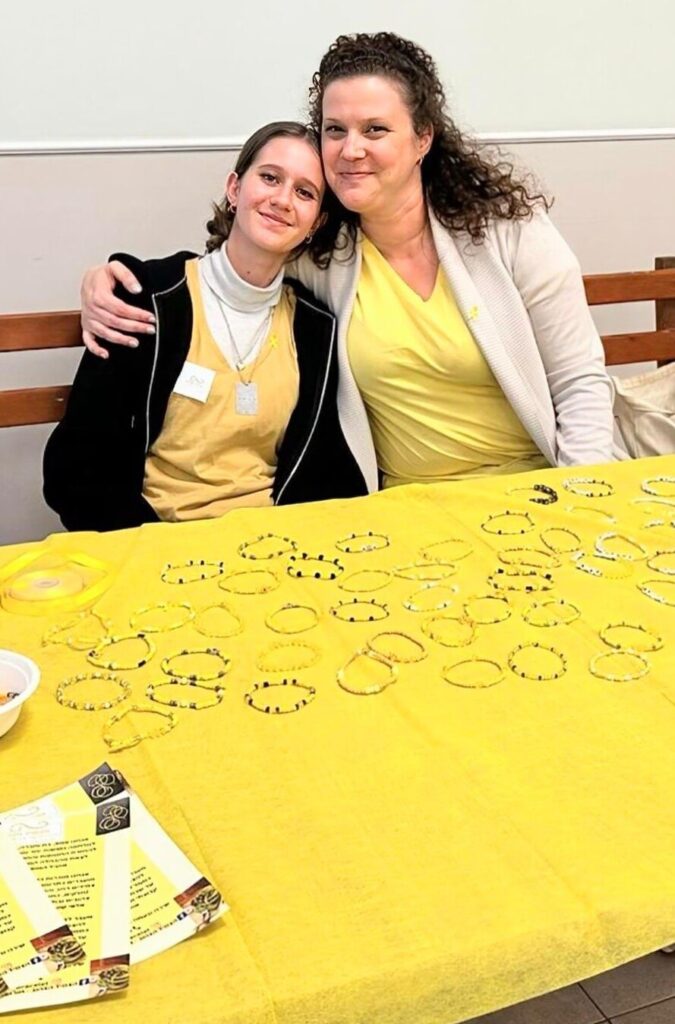
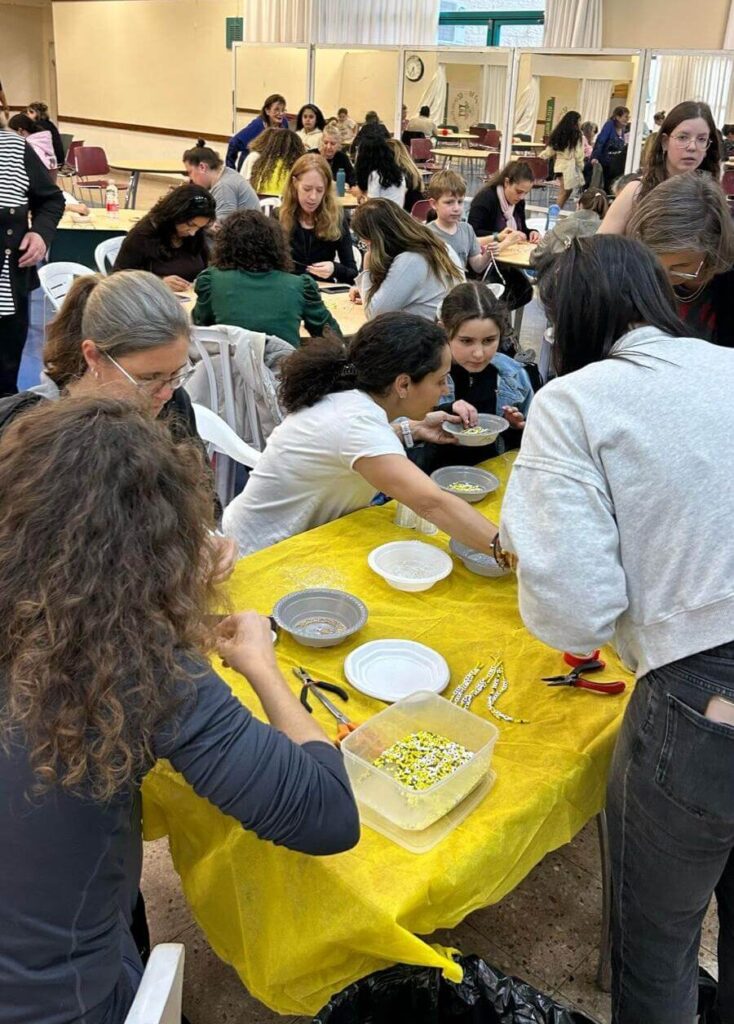
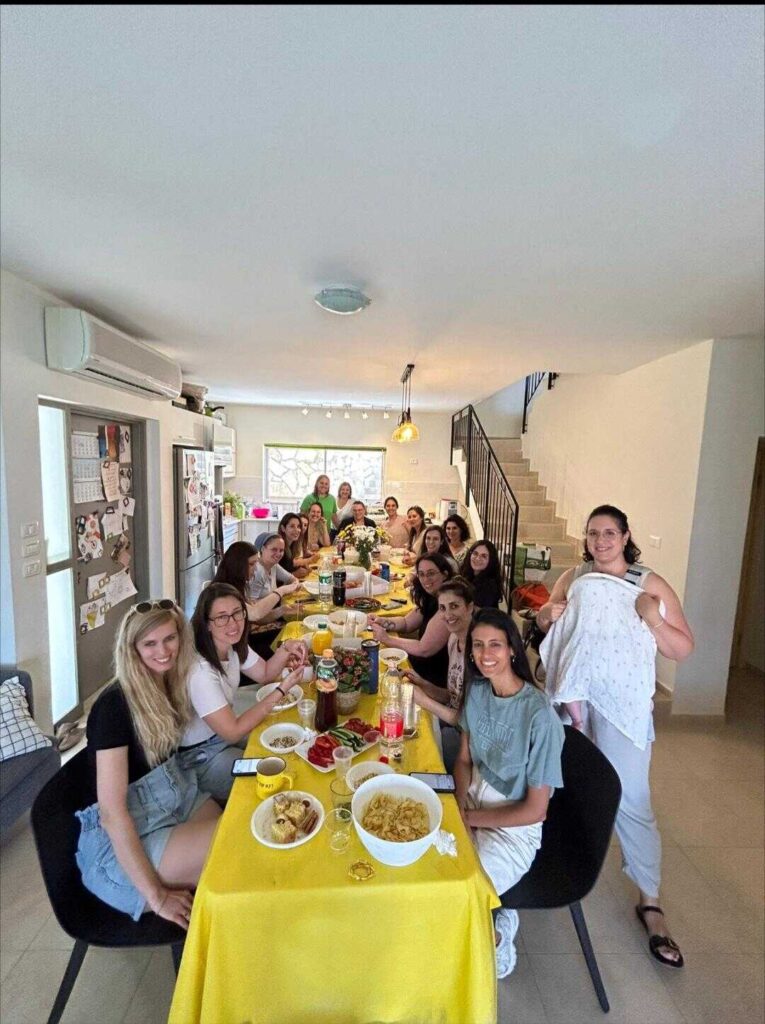
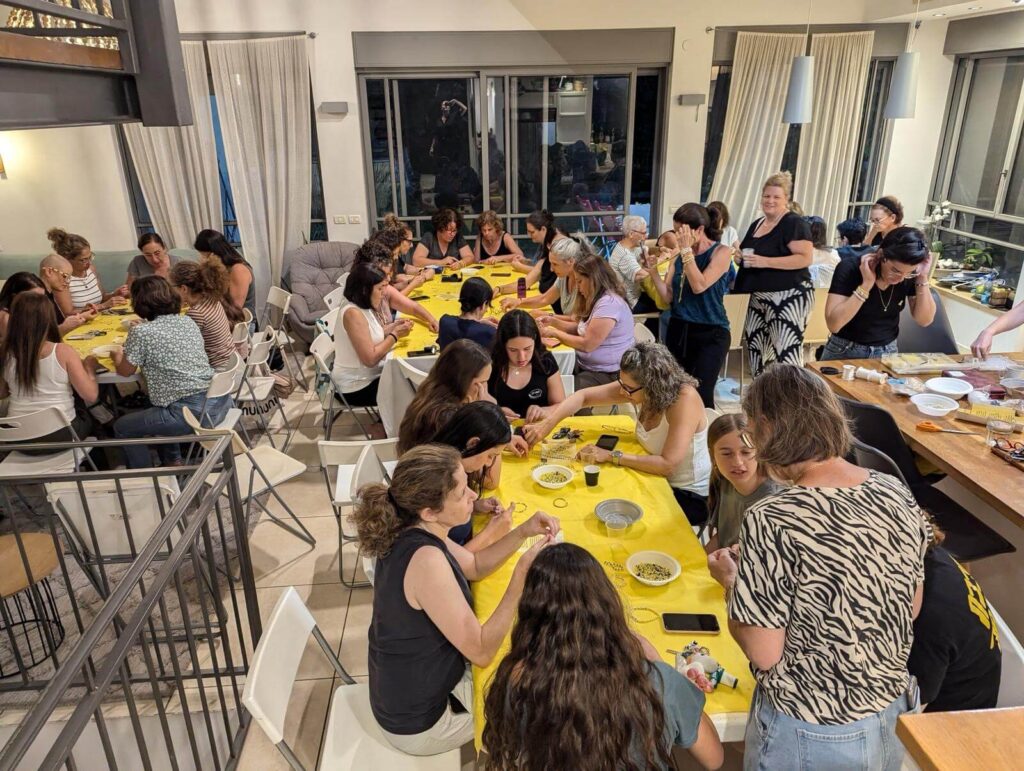
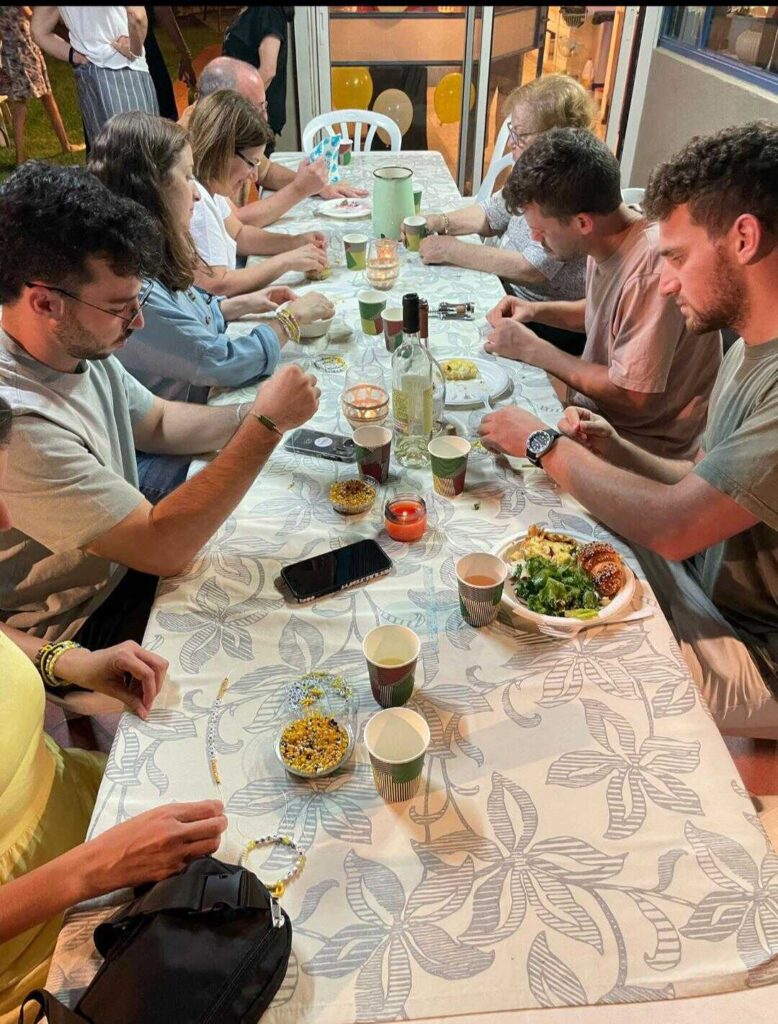
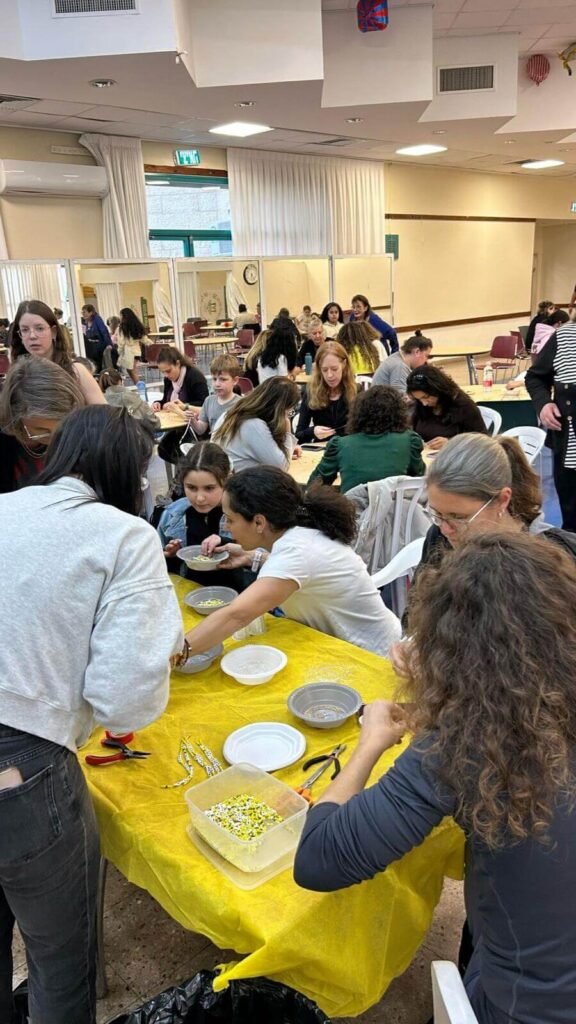
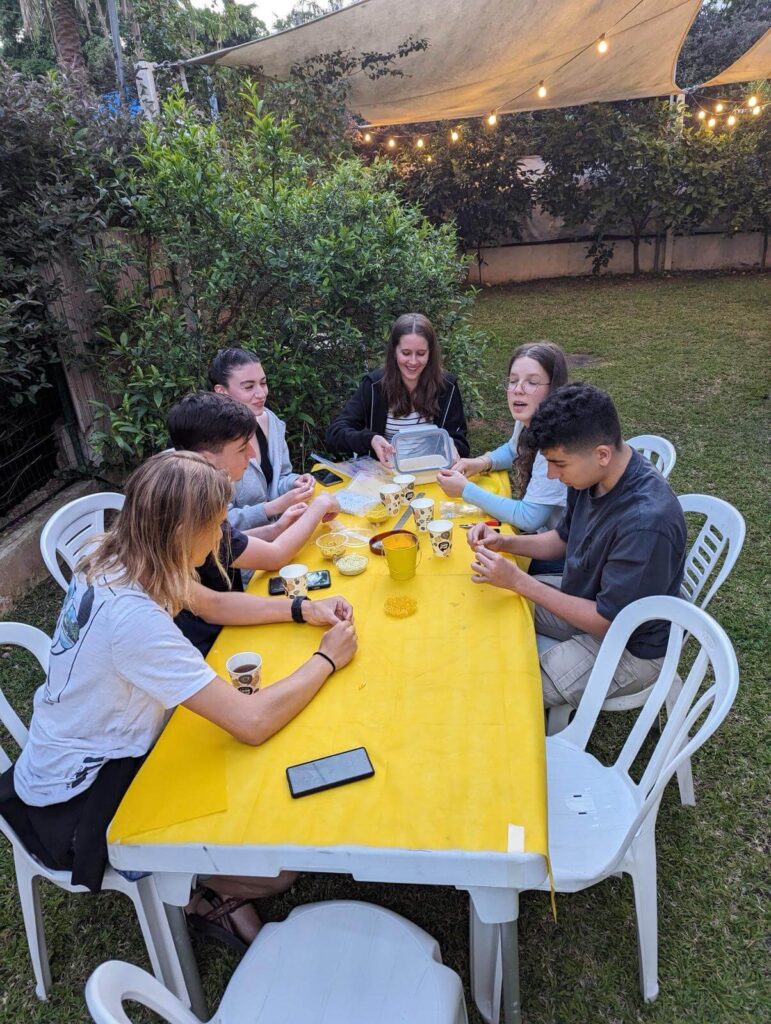
We reached displaced communities from the Gaza border region who were still living in hotels across the country, private groups, employee teams at numerous companies, nonprofit organizations, communities organized by local authorities, coffee carts, schools of every kind, programs for adults with special needs, student associations, and even weddings, beach parties, and all sorts of other events. Even at celebrations, people wanted to remind everyone that the ordeal was not over. We all had an opportunity, every single day, to contribute a small part to the struggle to bring everyone home. We would not let go until the fate of every single hostage was known.
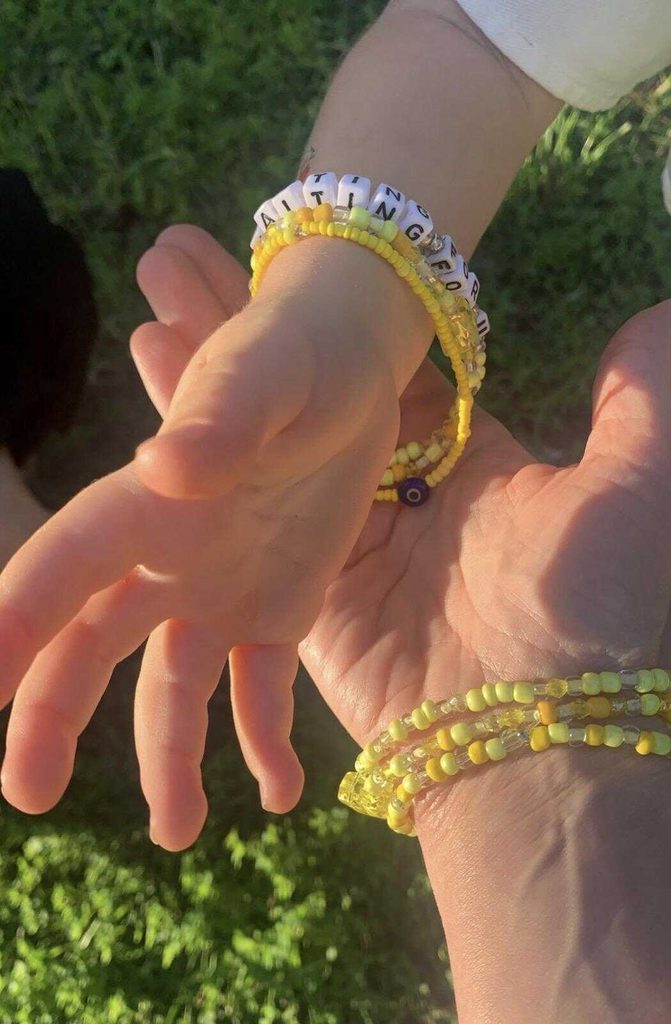
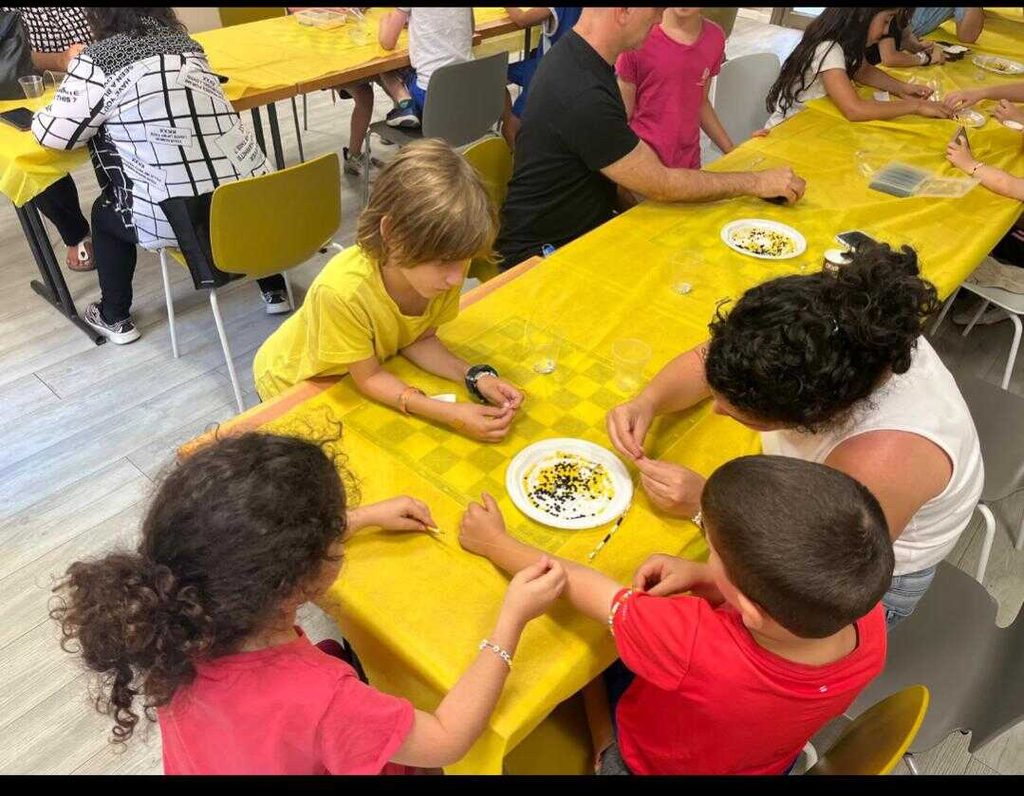
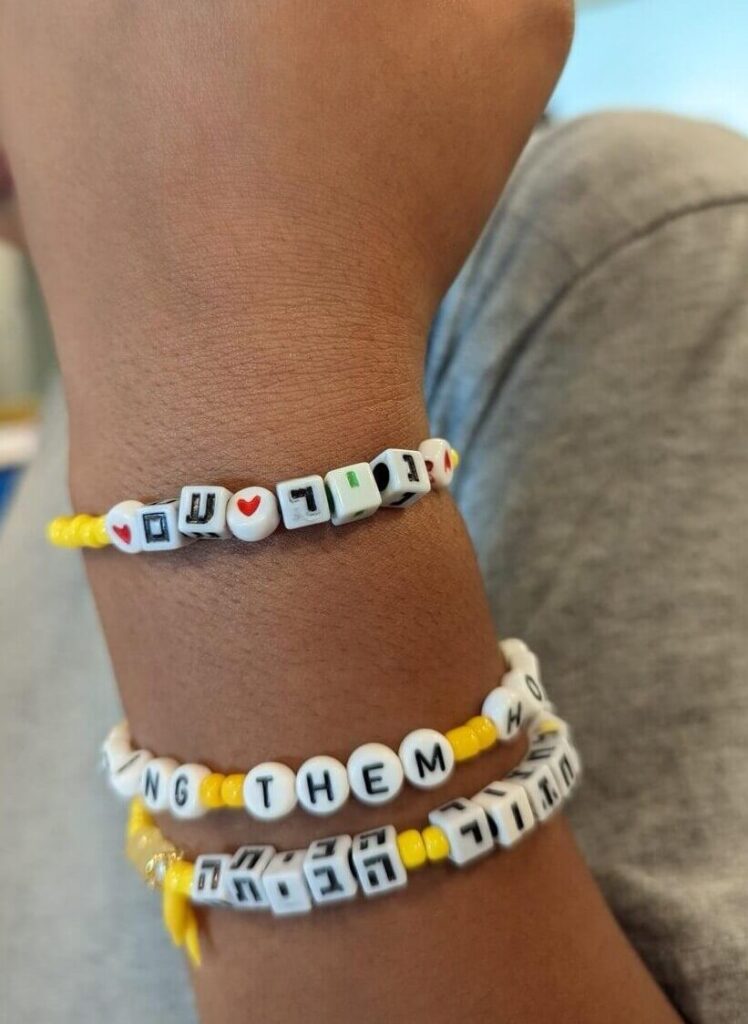
In March 2024, we formally partnered with the Hostages and Missing Families Forum. Hundreds of the Forum’s volunteers were trained, and the scale of bracelet-making grew significantly. The bracelets were sold at Hostages Square during major demonstrations. There were Saturdays when thousands of bracelets were sold in a single evening at those sales points alone. Our connection with the central Forum strengthened us and encouraged us to keep going. From then on, there was hardly a week without a workshop somewhere.
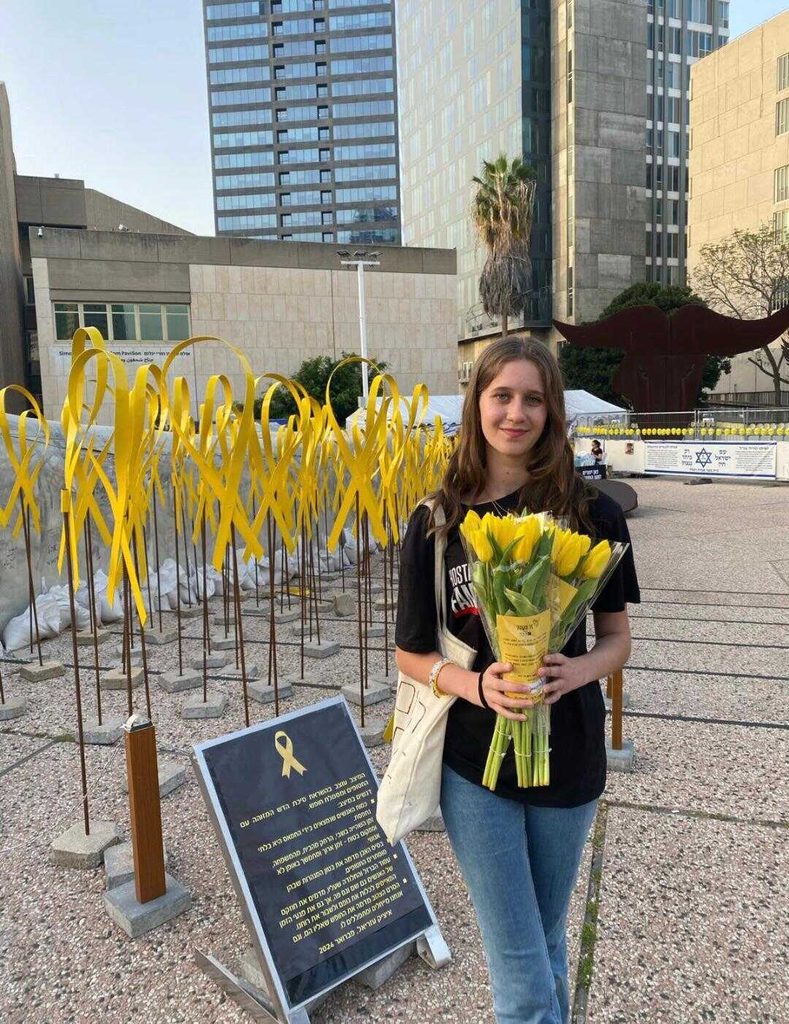
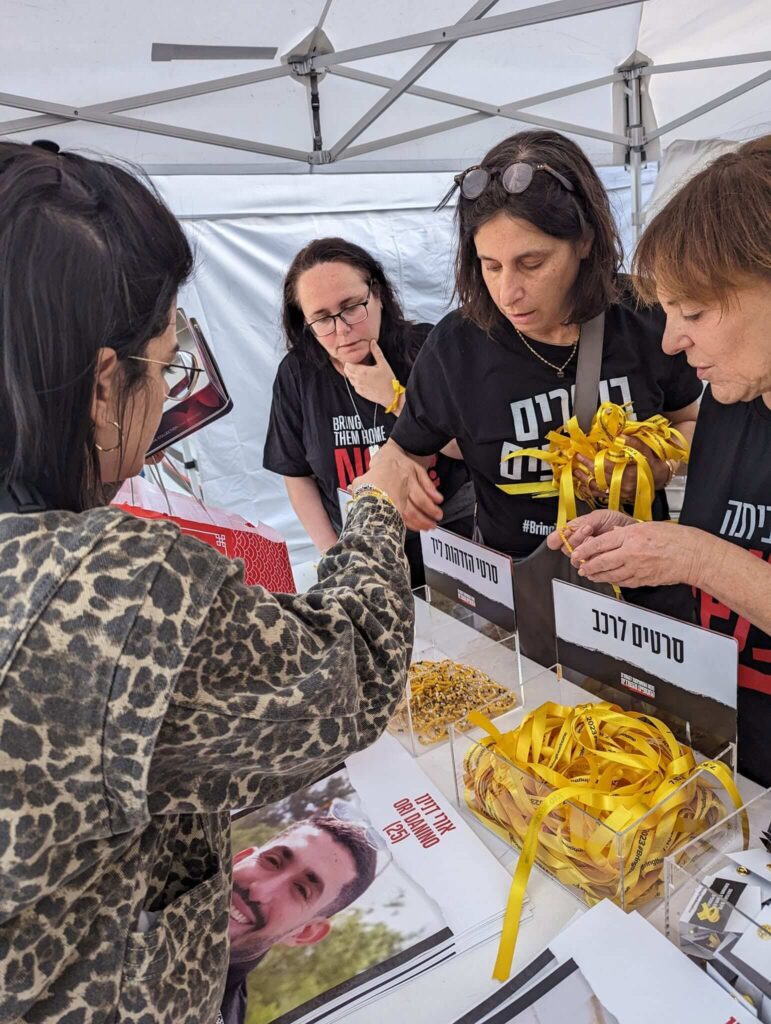
We also started carrying a small supply of bracelets in our bags whenever we left home, ready to take advantage of any opportunity to distribute them further. We also kept them on hand in case we happened to encounter particularly well-known or influential people, whether by chance or otherwise. That happened quite often, and every such encounter helped push the project forward.
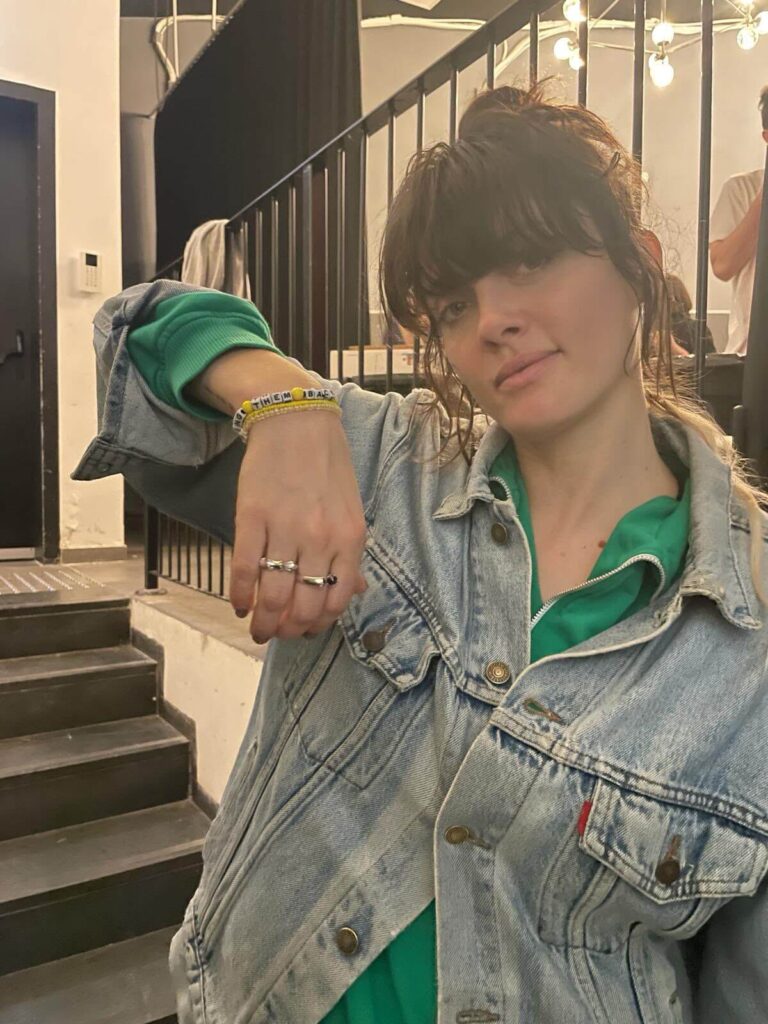
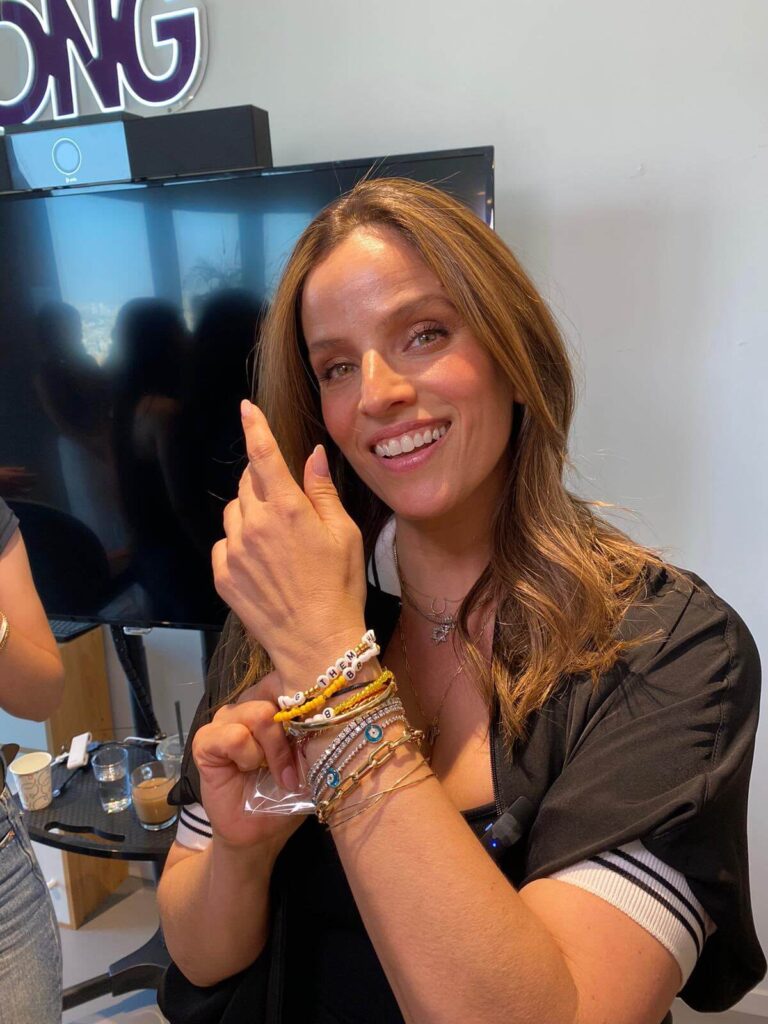
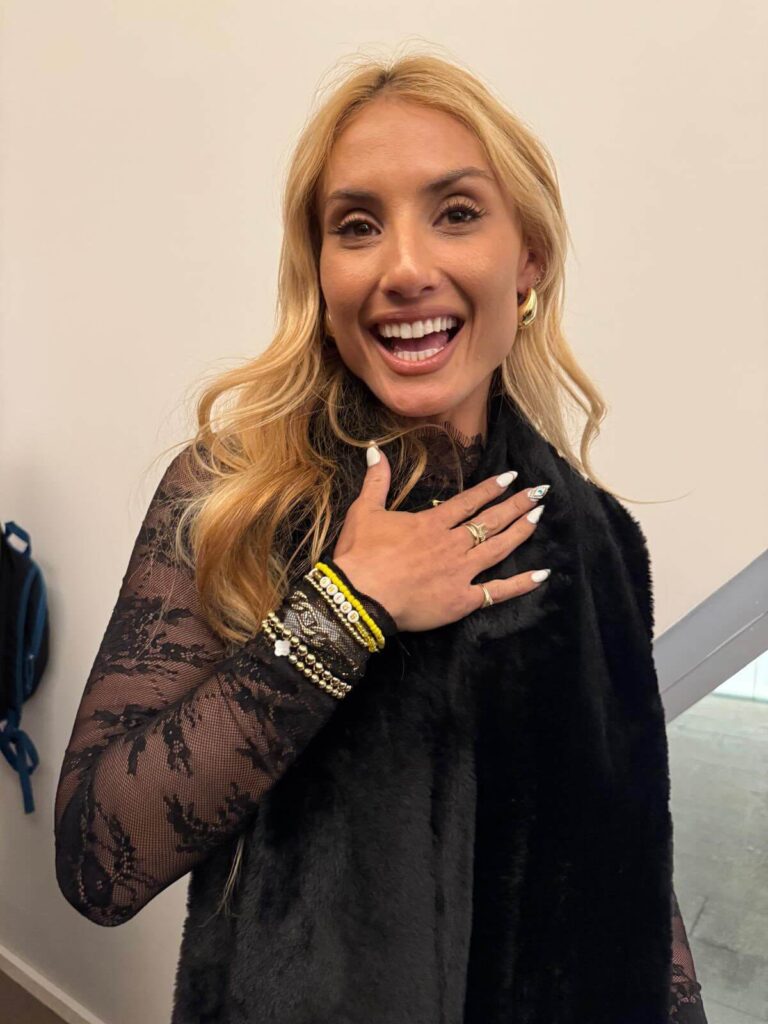
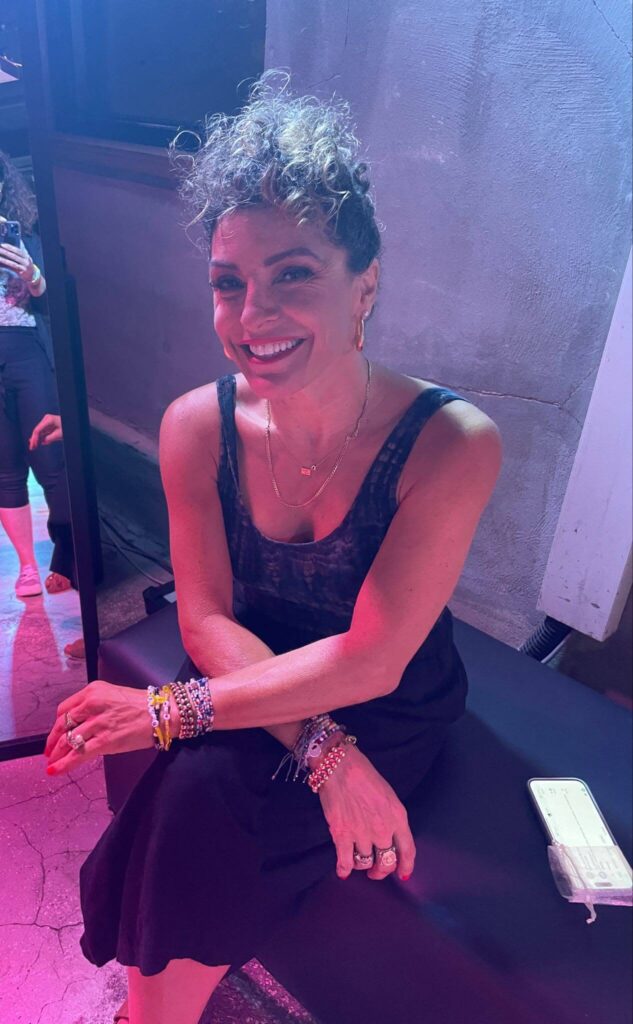
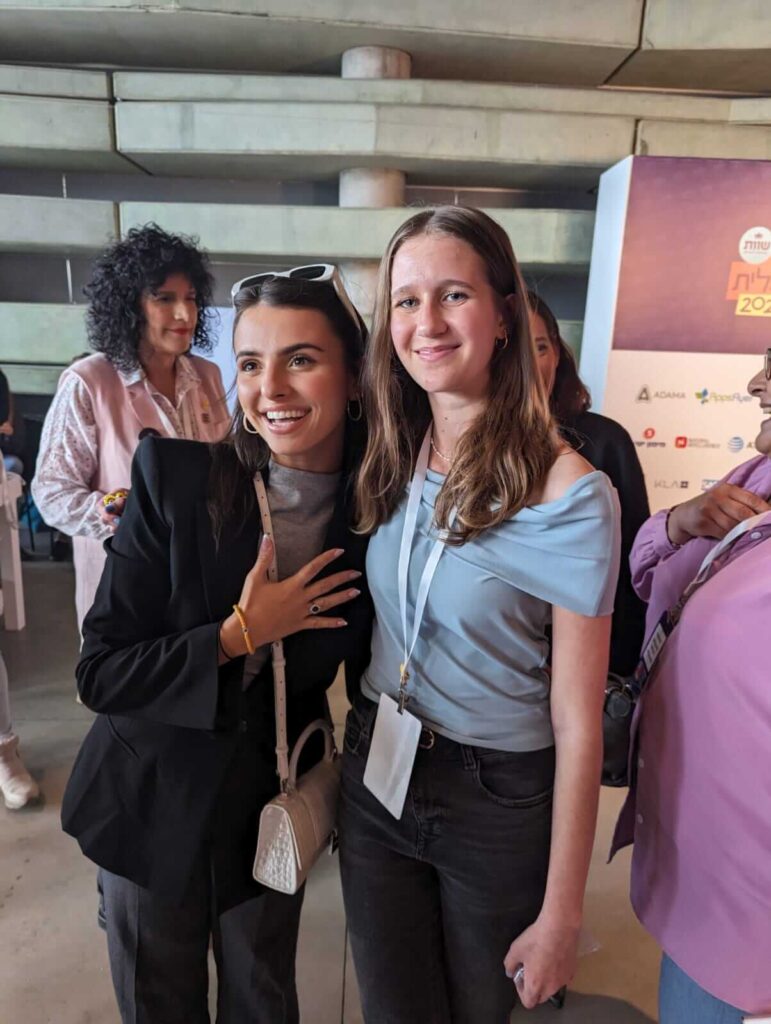
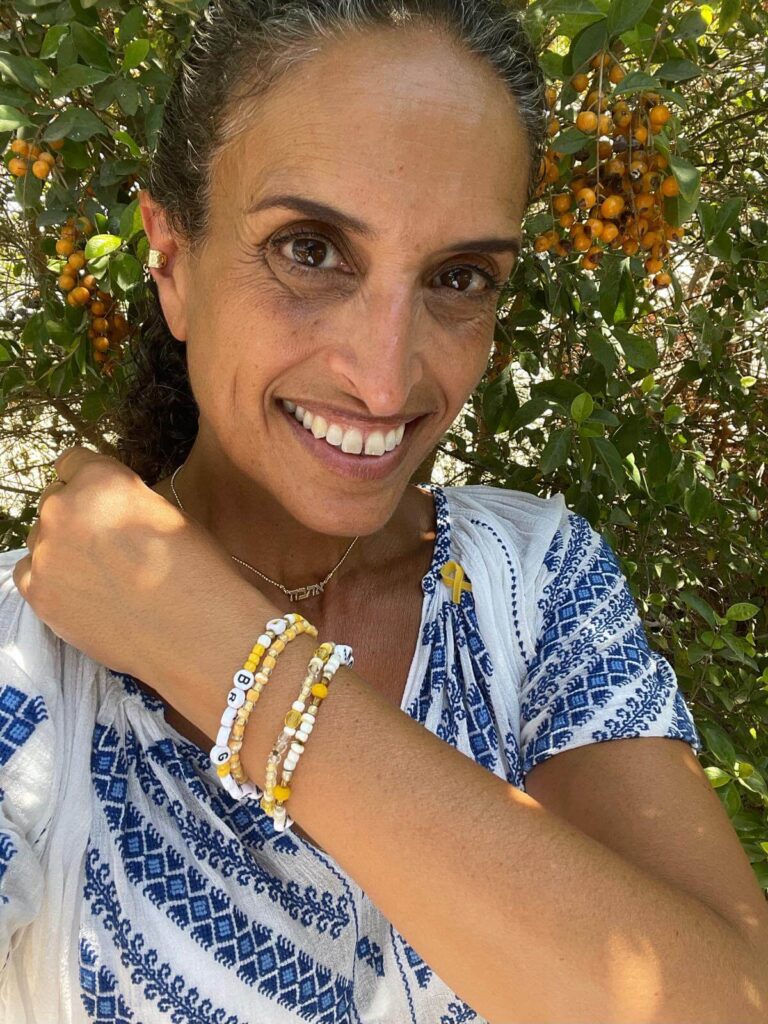
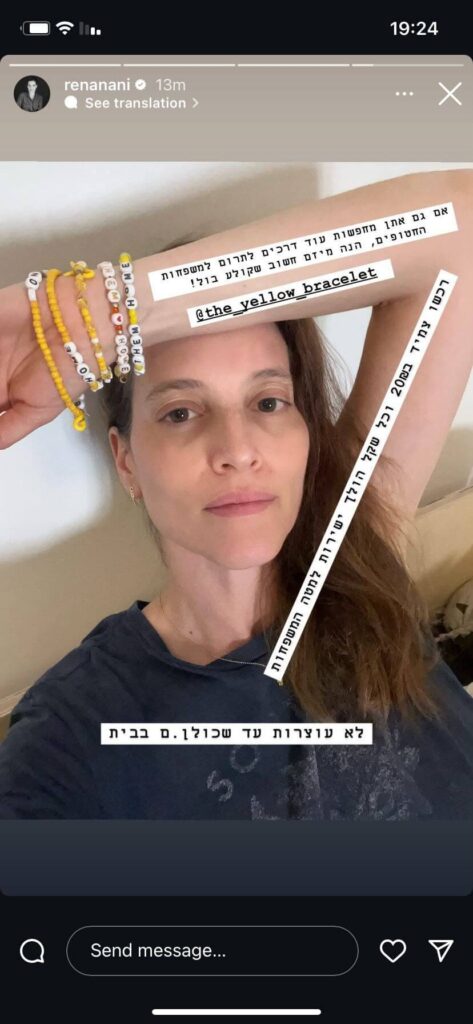
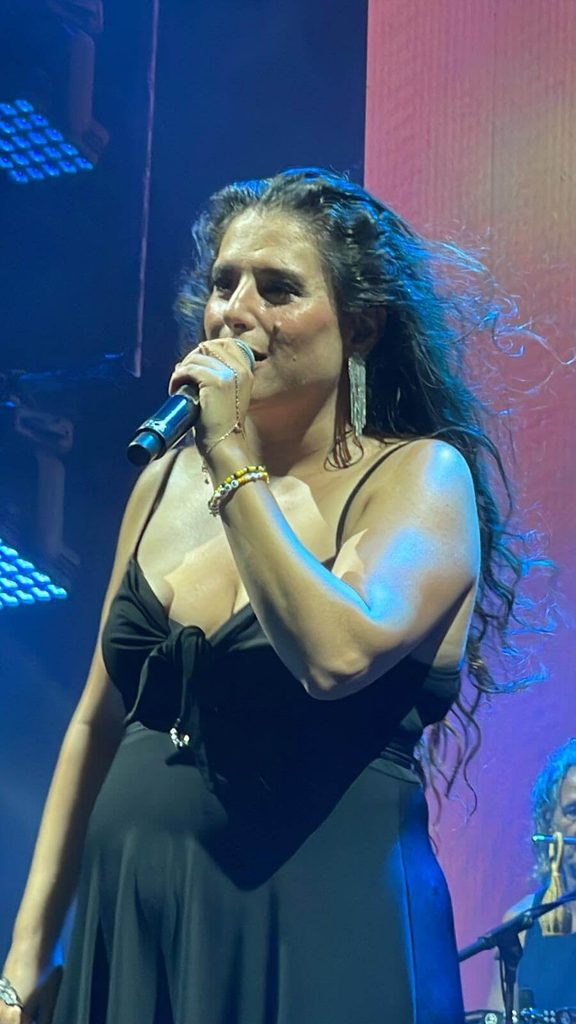
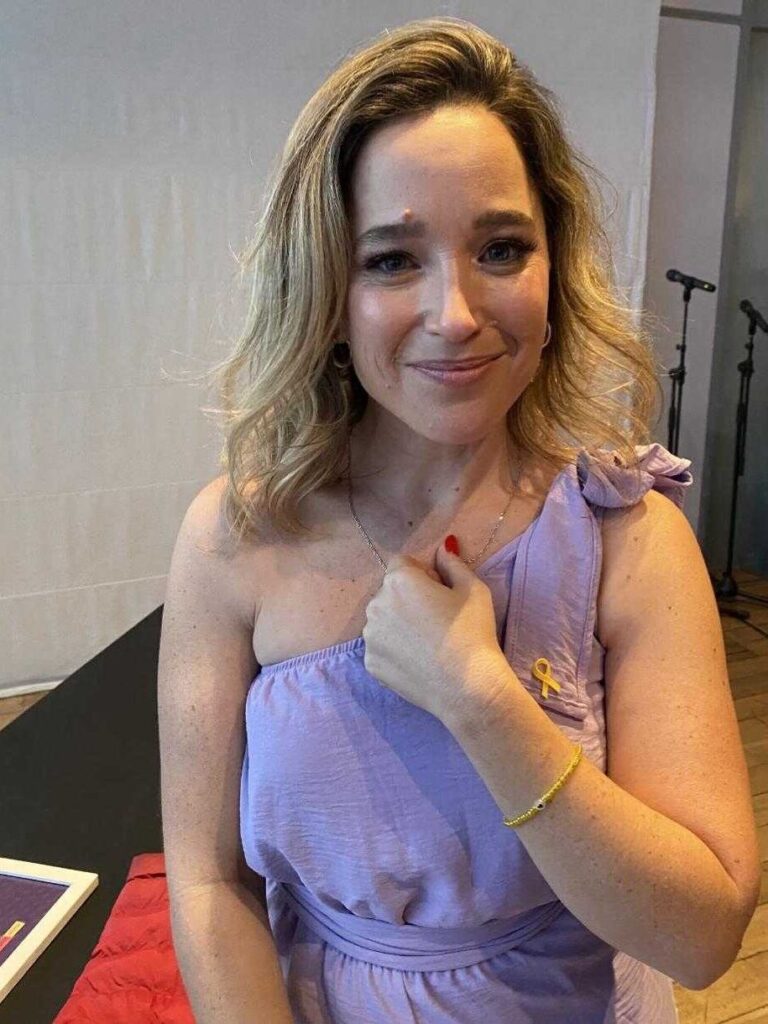
Every few months, for reasons I can barely understand in retrospect, we would get the feeling that everything was about to work out, that there was no point buying more beads because we would soon no longer need them. That was how we felt in December 2023, when we thought the first hostage deal would bring the whole ordeal to an end. Each time, we imagined ourselves throwing away all the yellow beads, the letter beads, the little ribbon symbols, and all the other supplies. And each time we were proven wrong, our hearts broke a little more, another small piece at a time.
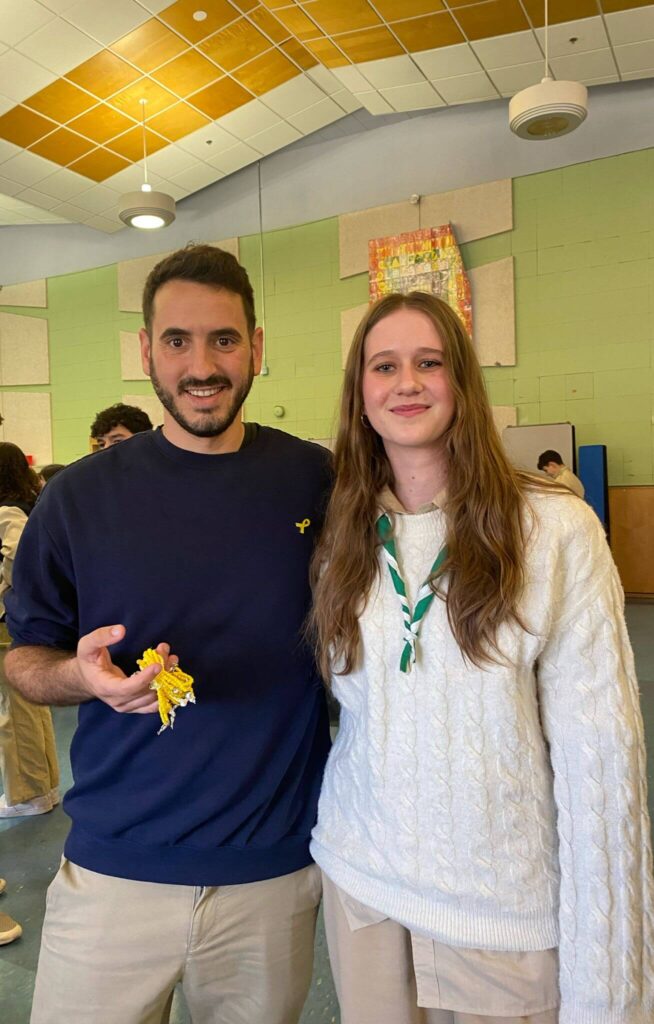
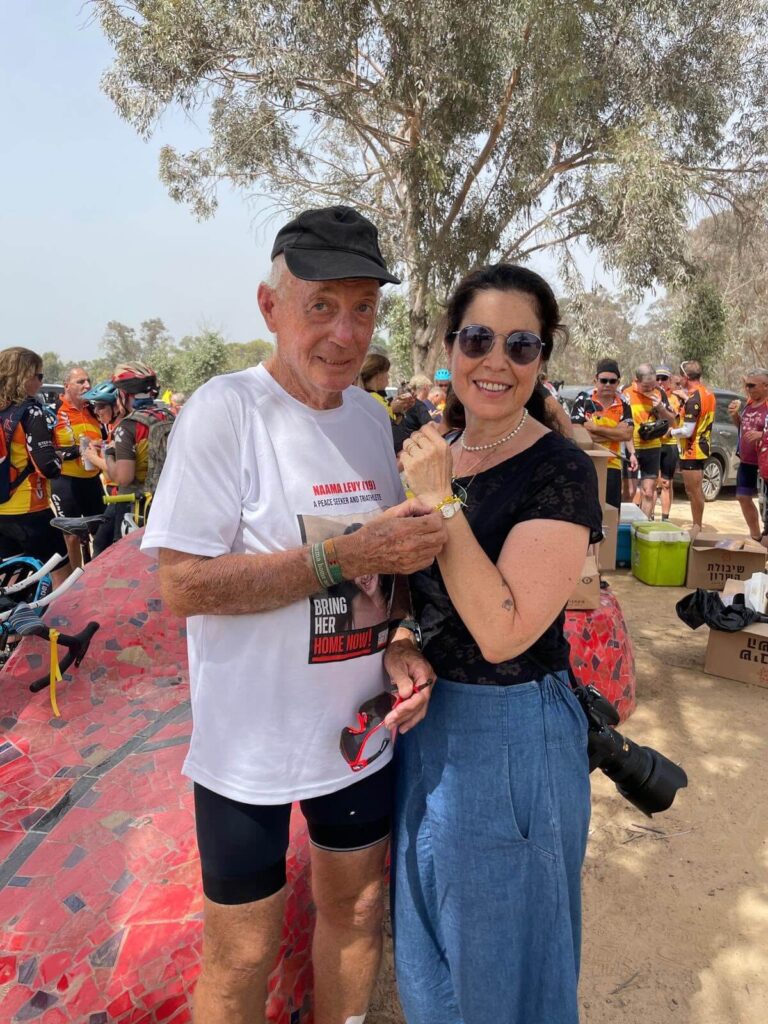
And yet, we continued. From the very beginning, beneath the project’s name, “The Yellow Bracelet,” we wrote: “Beading Until Everyone Comes Home.” There were days when that sounded like science fiction, when it seemed we would either be making bracelets forever or would be forced to break that promise. And yet, we continued.
From Israel to the world
In July 2024, after many long and difficult months of farewells and closing chapters, we moved to the United States. We knew that, whatever happened, we would find a way to continue from there. We tried not to feel as though we were abandoning our post before the work was done. And we didn’t abandon it. Shortly after arriving, we made connections with volunteers in different states across the United States. Through online outreach, we expanded our activities within Israeli Scouts groups, Jewish community centers, and other settings. The pace and scale were different, but we knew we were continuing, despite the differences. Here, solidarity with Israel was generally expressed through a blue bracelet or a blue fabric ribbon, often accompanied by a sign of support displayed outside one’s home. As I mentioned earlier, the yellow bracelet is a universal symbol, and outside Israel it isn’t necessarily understood as referring specifically to the struggle to bring the Israeli hostages home. We continued to hold beading workshops in a wide range of settings and received support from Israeli families in the community, which also gave us the opportunity to get to know them.
I admit that sometimes, alongside the challenges of settling into a new country, the different character of the project here left me feeling a little alien and out of place. I also missed the sense of shared purpose with our partners back in Israel, who had experienced those days there, from the very beginning. Over time, I came to understand a little more about how October 7 and the period that followed had been experienced here, and how deeply they had affected the local population. Those effects, of course, are still very much present and significant.
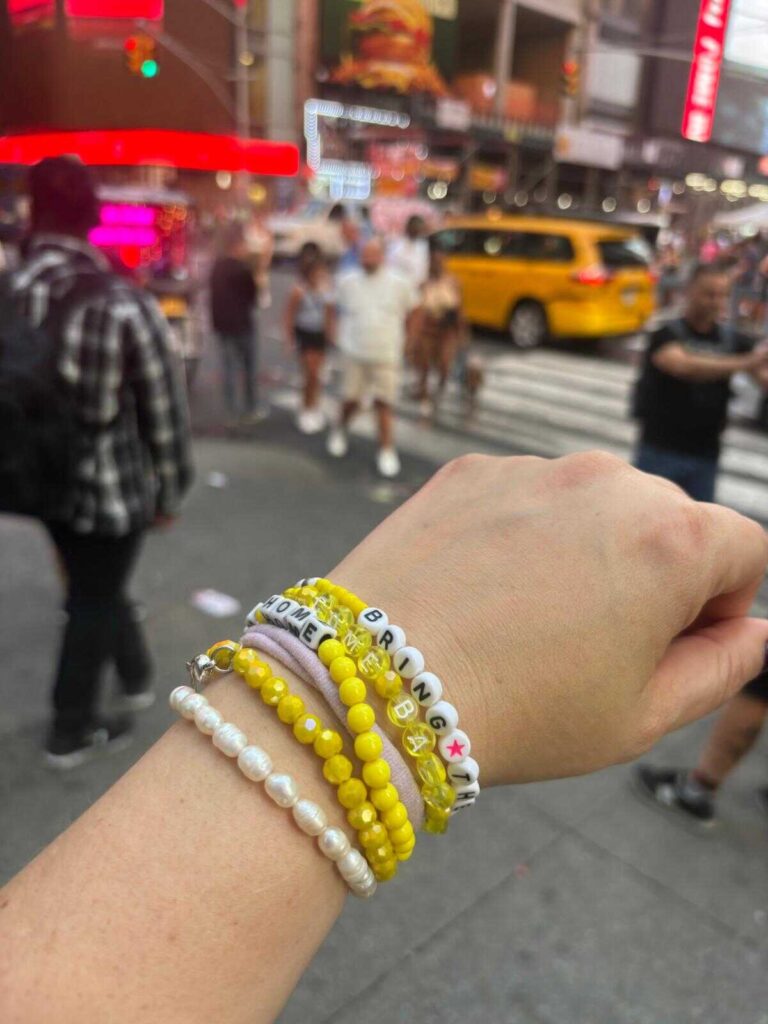
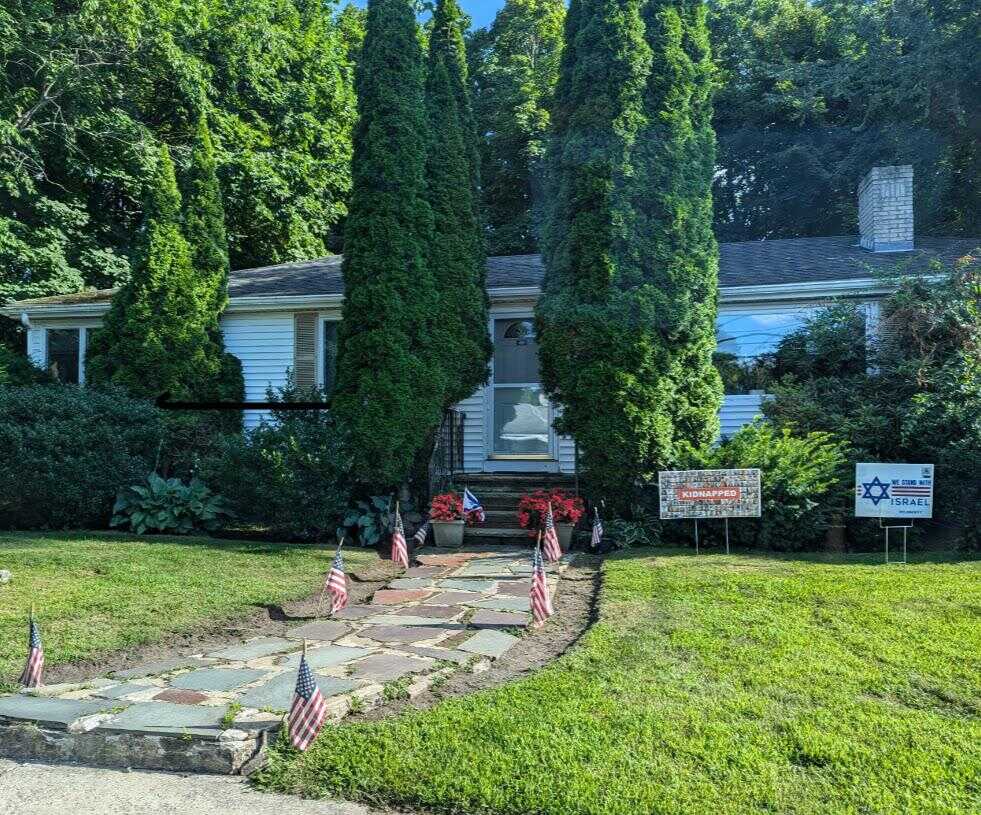
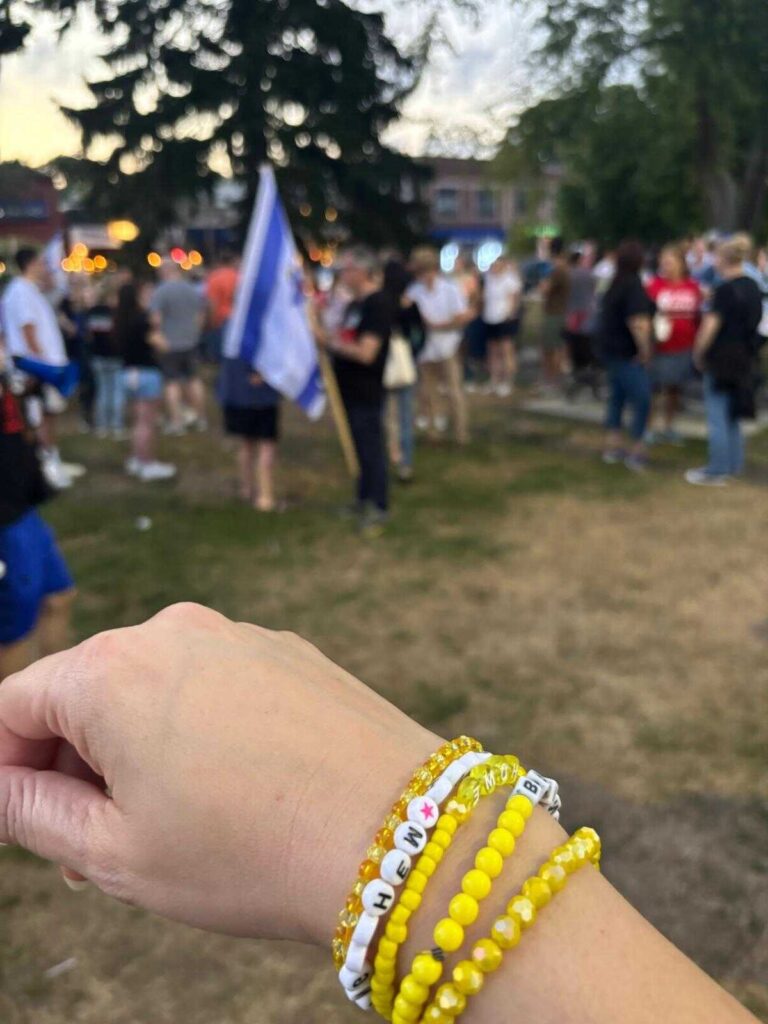
There was comfort, though, in the feeling that we had brought something else from Israel with us, something that allowed us to contribute to supporting the hostage families and feel part of that effort. Sitting together and stringing Hebrew letter beads that I had brought from Israel, adding a tiny Star of David or a blue evil-eye bead to a bracelet here: suddenly, those bracelets carried a new kind of power. During our first year here, we had many visits from family and friends, and we sent countless bracelets back to Israel with them. Sometimes we would meet people who had traveled to Israel to visit, attended demonstrations, and returned from Hostages Square and from Israel with a bracelet we had made here, one that had traveled all the way there and back again. I’m still getting used to the fact that my “here” is no longer in Israel. Sometimes I still get confused when I talk about “here” and “there,” even though Boston has been my “here” for two years and three months now. I wonder if that will ever change.
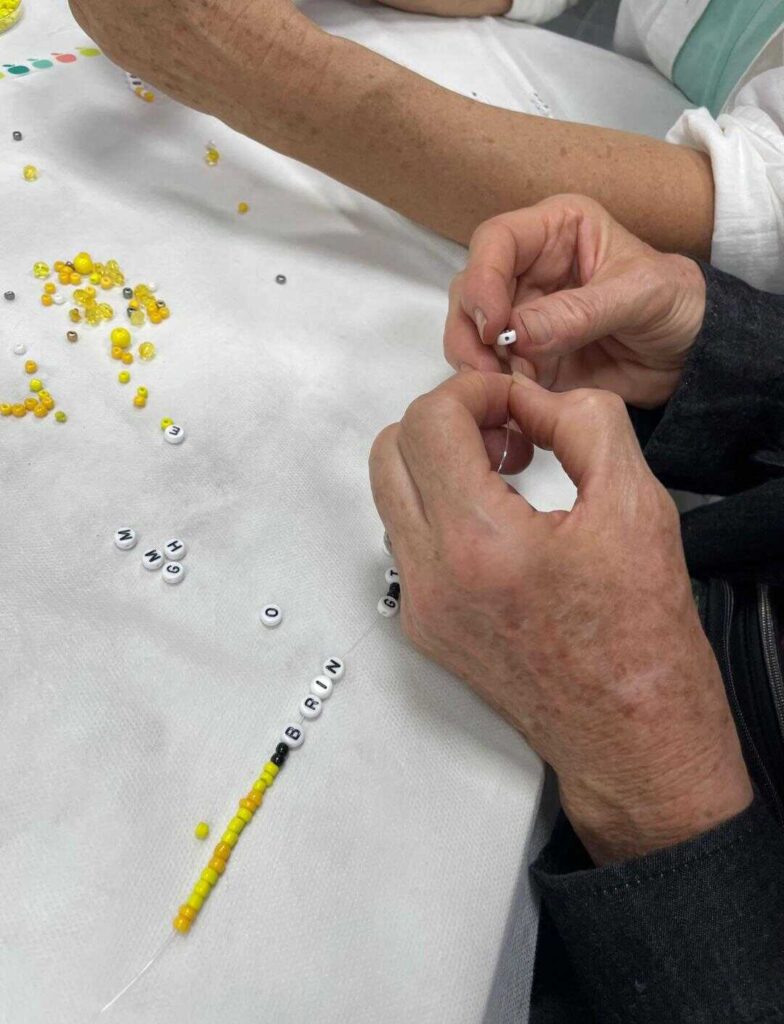
The last bead
In January 2026, something happened that had become difficult to believe possible: the body of Ran Gvili, of blessed memory, was returned to Israel. He was the last hostage whose fate had remained uncertain. With his return, a chapter in an agonizing period finally came to a close. It had felt like a reality show written by screenwriters from hell, with participants cast against their will and by force, chosen entirely at random. Any one of us could have found ourselves playing the leading role in this nightmare. That understanding was what kept us going: the belief that if we had been the ones taken, people would have cared about us and fought for us.
I haven’t thrown away the beads or the bracelets. I never planned to build a project on this scale, one that would provide significant emotional and financial support to so many people, and not just to my own daughter. I never imagined we would have to fight at all to bring the hostages home, certainly not for so long. I never imagined we would have to keep acting to ensure they weren’t forgotten, or that they were running out of time. Those were phrases we wrote on signs back then. When I think about them now, I still hold my head in disbelief. I cannot believe there was ever a need to state that they were running out of time, that everyone needed to come home, that ensuring their return was the duty of a functioning, sane country. And even when the contract between us and our country had been so brutally violated, we still cared. As women and as individuals, as a society, as Israelis, whether in Israel or wherever we might find ourselves.
Pain, comfort, and brief flashes of satisfaction mingle when I think about this project. I also feel enormous gratitude for the many women who chose to join us (first and foremost, of course, my co-leader, Naama Rivlin Angert), who persevered, stayed with us through it all, grew discouraged alongside us, and then pulled themselves together and kept going until the very end. More than anything, I feel proud of my own Naama, my daughter, who did so much, took the lead, and dealt with situations that were genuinely challenging for someone her age. And still, she kept going without giving up.
I am nowhere near understanding or processing everything that has happened over the past three years, either nationally or personally. But I know that choosing to show solidarity and reach out in this particular way will stay with me for the rest of my life. I will always feel at peace with that choice and proud of it. And I will do everything I can to ensure that, in my immediate surroundings, wherever my next “here” may be, I do not stand by and look away. I will keep finding ways to weave connections and create more togetherness in the face of so much loneliness and that elusive, unstable sense of community. This ending has become a little “Miss Universe,” I know. But this really is a central goal for me. The more time passes, the more I understand that it may well become a life’s mission, and that it is far from simple, anywhere, and certainly not as an Israeli.
There is still so much more to tell about every gathering, every workshop, and every change along the way.
Although it isn’t easy to think back on this period, this project brought a great deal of light into our lives. I hope that reading about it has brought even a tiny fragment of light or hope, and perhaps a new perspective on things that may seem simple, small, or incapable of making a difference.
I’m including links to the project’s social media pages, which are still available to visit,
They are like a sketchbook documenting the gradual, evolving process through which everything took shape, or a memory book preserving things we must never forget.
And if you’ve made it through the whole piece, leave a sign in the comments on the platform where you read it; perhaps even include a photo from back then, wearing the bracelet. it would warm my heart to see it…
The Yellow Bracelet’s Instagram Page
The Yellow Bracelet’s Facebook page