There are so many things in life that, no matter how much people tell us about them beforehand, are incredibly hard, if not impossible, to truly understand until we experience them ourselves. Immigration is definitely a good example. And within that experience, there are countless smaller experiences that come together to form something that’s hard to fully grasp until it becomes part of your life, and even then.
One of those experiences, for me, is the basic, ongoing feeling of not being understood. At first, I felt like I was the one who didn’t understand things, but gradually, the longer I’m here, the more I understand, even though I still don’t always feel understood. My English is actually pretty good, and I feel increasingly confident expressing myself freely and in ways that fit the culture here. Still, even though I was never someone who held back from speaking before I moved, I now find myself staying quiet much more than I’d like, often giving up before I’ve even tried to make myself understood. It makes me sad, but I believe this will change with time, and that it’s about cultural differences as much as language. I’m also coming to terms with the fact that, in many people’s eyes, I’ll always be different, and I’m okay with that. At the same time, I’m happy to discover that there are people around me who truly see me, who see my soul beyond where I come from. When those connections happen, I know there’s a chance for genuine friendships without conditions. It’s incredibly encouraging and makes me feel more connected to the world and less like I don’t quite belong.
I don’t always feel understood when it comes to my artistic language, either. I say “embroidery” and immediately see that the other person is imagining something completely different from what I have in mind. Suddenly, I feel like I’m standing on one bank of a river, trying to build a bridge to the other side, and it doesn’t always work. By the time I get there, I’m not even sure anyone will still be waiting for me to finish explaining. Explaining that what I do with embroidery is broad and contemporary, that it’s about observing the world and translating what I choose into a language of thread, color, and layers. That you can blend colors in embroidery, that you can embroider on almost anything, and that the back of a piece can be just as interesting as the front. That there are endless possibilities for self-expression through this medium, even if you’ve never done anything “artistic” before, even if you think you know nothing about art or believe you’re all thumbs. That embroidery is so much more than what it was traditionally used for. And that those traditions are still places we can revisit whenever we want, because the meeting between old and new is fascinating in itself. And there’s so much more beyond all of that.
When I was writing my master’s thesis in art therapy, I remember my supervisor saying that if we couldn’t describe our topic or research question in a few simple words, it probably wasn’t clear or developed enough yet. She encouraged us to keep trying to communicate our ideas to others until they became clear, both to them and to us.
I’m not sure I could describe that research so simply even now, and I wonder whether that’s really how it works. Could it be that some things just aren’t simple, that they can’t be explained in a short, clear, accessible way? Maybe there are things we have to be willing to dive into to truly understand, to actually learn to speak their language. Maybe.
I think that despite how difficult it was to explain, it was still good research for where I was at the time. (It explored the boxes used to store artwork within the therapeutic relationship in art therapy, as a physical expression of the psychological space and the dynamic process of therapy itself. That’s the best description I can give looking back, and I’m still not sure it quite captures it.)
One of the greatest benefits of having opportunities to teach is the time I spend sitting with myself in the days before everything begins. Looking closely at what I do, asking questions about it (sometimes literally, “What the hell am I doing, and how am I going to make this clear to people who don’t live inside my head?”). There’s a lot of choosing and editing, along with accepting that I can’t teach absolutely everything. I need to stay focused, while also giving each participant the chance to discover for herself what feels right and interesting to her within the framework I offer.
Every now and then, I have one of those “Eureka!” moments when I feel I’ve found a new way to connect others to this language, to shift and expand existing ideas about embroidery and the practical possibilities of creating with it. And that’s when I start feeling really excited and curious about the sessions beginning this week. I can’t wait to see how it all works in practice, what will be just right and what will need a little more fine-tuning, like gently adjusting the strings of an instrument. I love developing teaching programs so much.
The differences between the formats also bring their own challenges, and it will be interesting to see how the groups develop, both in similar and different ways. In the Zoom group, we’ll be learning remotely through inspiration, shared observation, and hands-on exploration, in a more structured format that’s quite different from anything I’ve done before. Then there are the in-person groups at my home in Newton, and, for the first time, in Brookline. There will be quite a few changes in these groups too, and I’m excited to introduce them, both in the advanced group and in the new groups.
Another difference between the formats is the group size. The online group currently has ten participants (thank you to everyone who’s joined, I’m so happy to have you!), and there’s still room for more. Later on, I’ll open another time slot for those who can’t make Tuesday evenings (Israel time). Despite the challenges of geographical distance, I promise to be available for both individual and group support between sessions. I’m so curious to see where each participant will go with this language and how she’ll make it her own.
The groups in Newton and Brookline are intentionally very small, so I can spend one-on-one time with each participant as often as needed during the sessions, and help each person move in the direction she wants to explore. Some of the groups still have a spot or two left, maybe one of them is for you, if you’ve been waiting until the last minute or haven’t quite made up your mind yet.
Beyond the embroidery and the creative process itself, over time these groups become a warm and welcoming space for the participants, an anchor in their lives, where connections grow into something much deeper than simply being part of the same group. It’s especially lovely during the freezing winter months, when there are fewer and fewer reasons to leave the house, and suddenly there’s a cozy place to go, to do something just for yourself in good company. And above all, to feel understood, to feel that you’re speaking a language that’s gradually taking shape, one that’s both deeply personal and shared.
For me, that means so much.
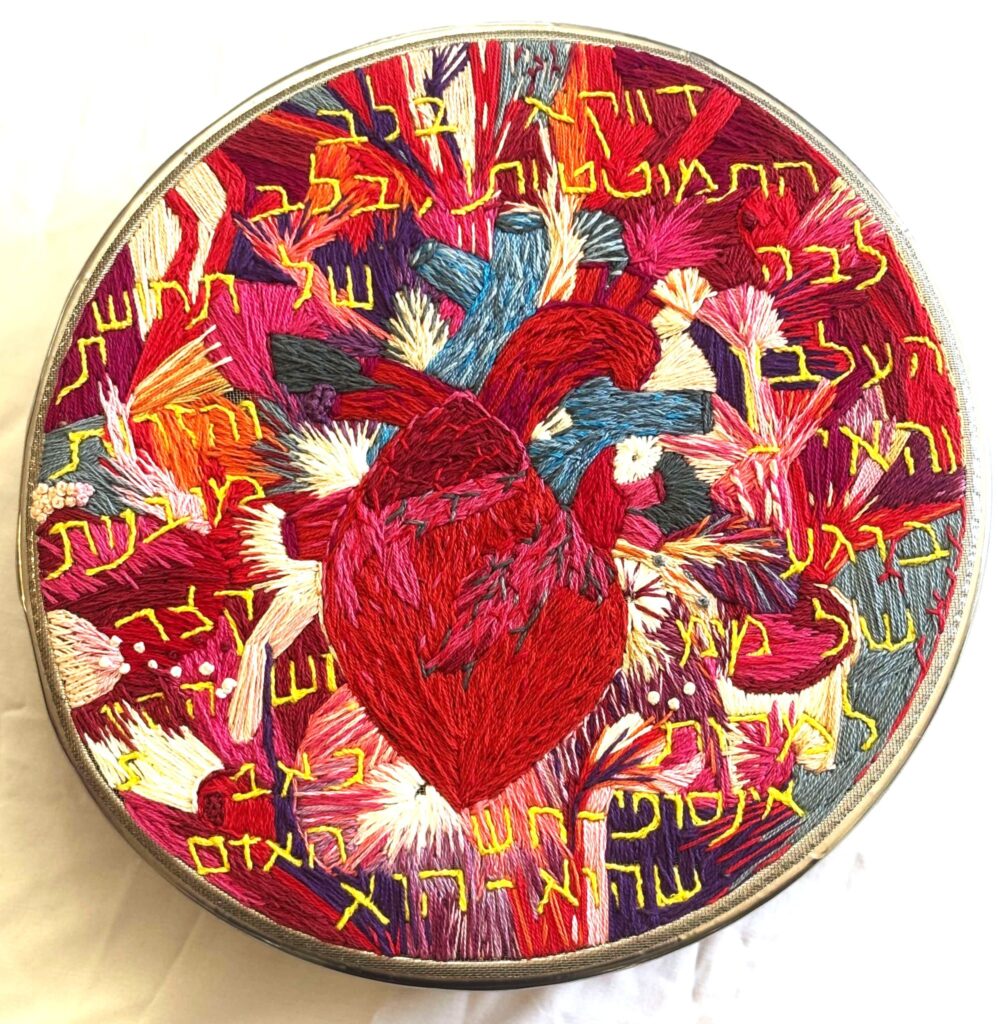
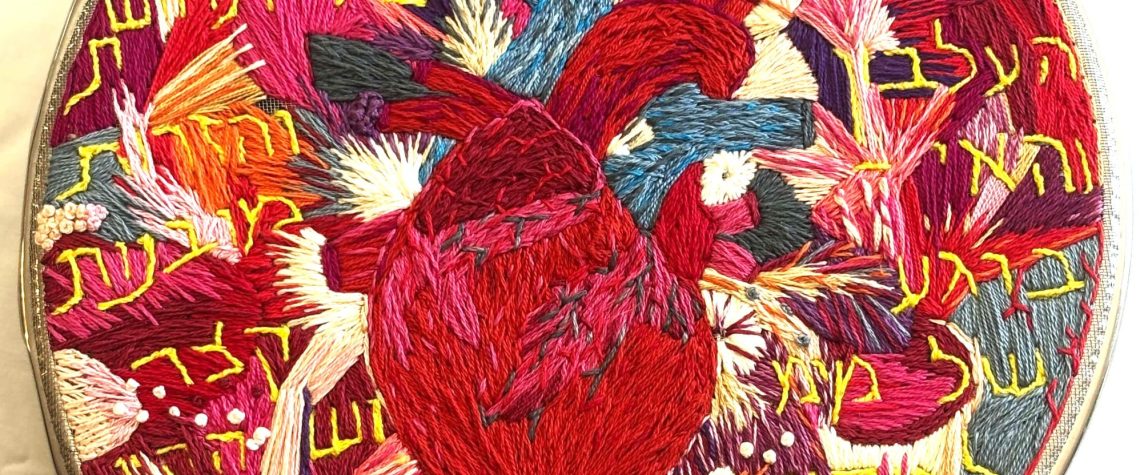
This embroidery piece is something I created during the pandemic, embroidered on a 25 cm diameter sieve. When everything is closed (and, as it turns out, even when it isn’t), you can embroider on just about anything you have at home…