
All this high tech, and the world still has no teleportation: some device like a London phone booth that you step into, press a button, and arrive somewhere else in a second. What are we supposed to do?
If I had one, I would certainly use it to beam myself to… Petah Tikva. Yes, really.
On my last visit to Israel, just hours before we left for Ben Gurion Airport, Yael and I went to the Petah Tikva Museum of Art to see “Thread and Absence,” an exhibition of works by Talya Kutz Shamir. Yael is my aunt but really more like a sister, an excellent photographer, and in recent years a colleague too, which makes me so happy! Talya is, first and foremost, a dear friend. She is also a colleague, a wonderful and sensitive art therapist, and at the heart of it all, an extraordinarily gifted artist. Everything she touches turns to gold, truly. It always has and always will. Think of anything in the world, and then imagine someone who, with her own two hands, can transform it into art of the finest kind imaginable, delving deep into the material, the making, the thought, and the idea. That is Talya.
In the first days after October 7, when everything was still so chaotic and my workplace was a psychiatric ward, with all that implies in a situation like this, I kept one eye on my phone, waiting for news from Talya about her family. Talya is from Kibbutz Kfar Aza. At the time, her parents, her older brother, and his entire family still lived there. After several agonizing days, the horrifying reality became clear: Aviv, Livnat, Rotem, Yiftach, and Yonatan, may their memories be a blessing, were murdered that morning as they huddled together in the safe room. A loss beyond words.
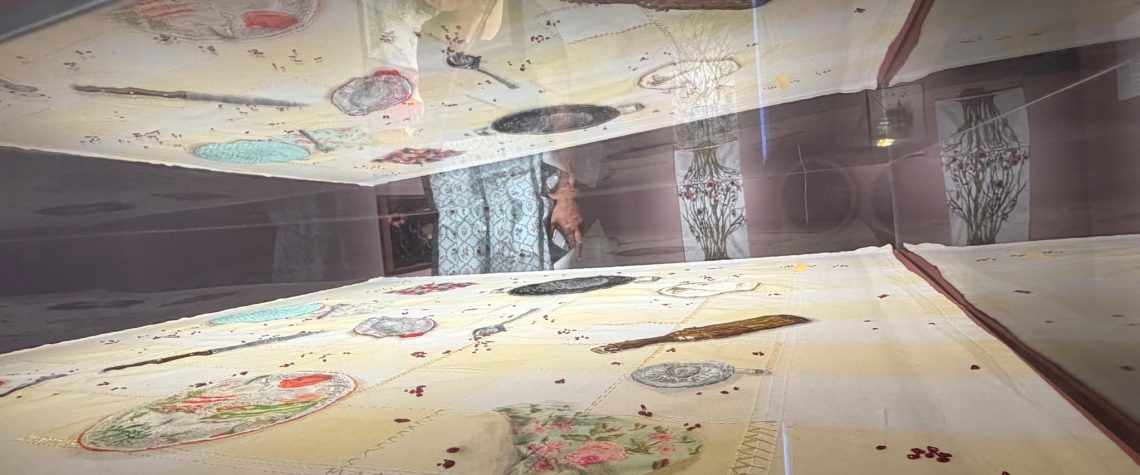
Wanting to reach out and make a connection with those who had been there and were no longer, Talya returned to the house in Kfar Aza several times in the days that followed and collected clothes and fabrics laden with meaning and memories. They became the ground for simple images of family life, both immediate and extended: scenes from her dear nephews’ childhoods and ordinary moments of home and life. A mother holding a child, grandparents and grandchildren celebrating a holiday, a brother flying a kite in hope of peace and better days. Flourishing nature, a home, a family meal. Through her choice of these moments and her remarkable devotion to an unforgiving, slow medium that demands attention with every tiny line, Talya managed to give physical presence to those who had been there and were no longer. She truly made them present, tangible in art. Her choices are so precise that they create recognition and connection with people I never knew and yet miss terribly, people whose absence is felt in the world, whose far too short lives left so much meaning and made such a difference to those around them, each in their own way.
I was surprised to encounter a video work, too. In it, Talya included her father, narrating and speaking from the heart. With such gentleness and wisdom, she found another way to bring to life the themes she explores: the longing for life on the kibbutz and for the meaning of a home and a place that will never be as they once were.
So many artistic expressions and responses have grown out of that terrible time. It is deeply unsettling and awful, yet there is also so much strength and hope in seeing something beautiful grow from unbearable rupture. People who have lost so much find a language beyond words, offer it to the world, and enter into a dialogue with it and with us as we experience it.
Even before all this, and in those very first days, Talya insisted to me, and I think to everyone she spoke with, that we must keep looking for beauty in small things. Search for it with effort and insist on finding it. Go outside and find beauty even on the scale of a snail, a grain, in the clouds, in something.
Do not give up on it, and do not let myself give up on it.
I will never understand where she found, and still finds, the strength to encourage others, to pass on that important message, to lift her head with such astonishing humility and quiet, steadily and without compromise. I will always cherish the strength she had to say goodbye to me in a beautiful, meaningful way, to let me go and want me to succeed, to understand this move and embrace me through it, to stay close and genuinely connected after I left Israel, to support me (!) through crises and heartbreak. To take an interest in what was happening before, and not give up afterward, even when I am not myself.
I am very lucky to have her in my life in so many ways.
Embroidery is a very shy medium and not particularly photogenic. It is truly difficult to capture its power, its labor, and its quality in a photograph. Even so, I am sharing a few photographs of the works here, including one Yael took that I especially love. As I said, she knows what she is doing.
[All attached photos of “Thread and Absence”]
“I recommend it” is far too small and feeble a phrase to convey how worthwhile it is to see these breathtaking works, which break and mend the heart, in the exhibition itself.
The exhibition is on view at the Petah Tikva Museum of Art until October 31, 2026. That is good news even for people who live far away or outside Israel and will visit before then, or in the very last week of October…
I am also including links to Talya’s Facebook and Instagram pages so you can follow her.
